Hyperinflation/Archive

Cases / World War II / Hungary

Hungary
1945–1946

The worst hyperinflation on record. After a war that destroyed most of its industry and transport, and under Soviet occupation and reparations, Hungary financed the state with the printing press.

41.9 quadrillion %prices in the worst monthJuly 1946
15 hoursfor prices to doubleat the peak (Hanke & Krus)
Aug 1945 – Jul 1946above 50% a monththe hyperinflation itself
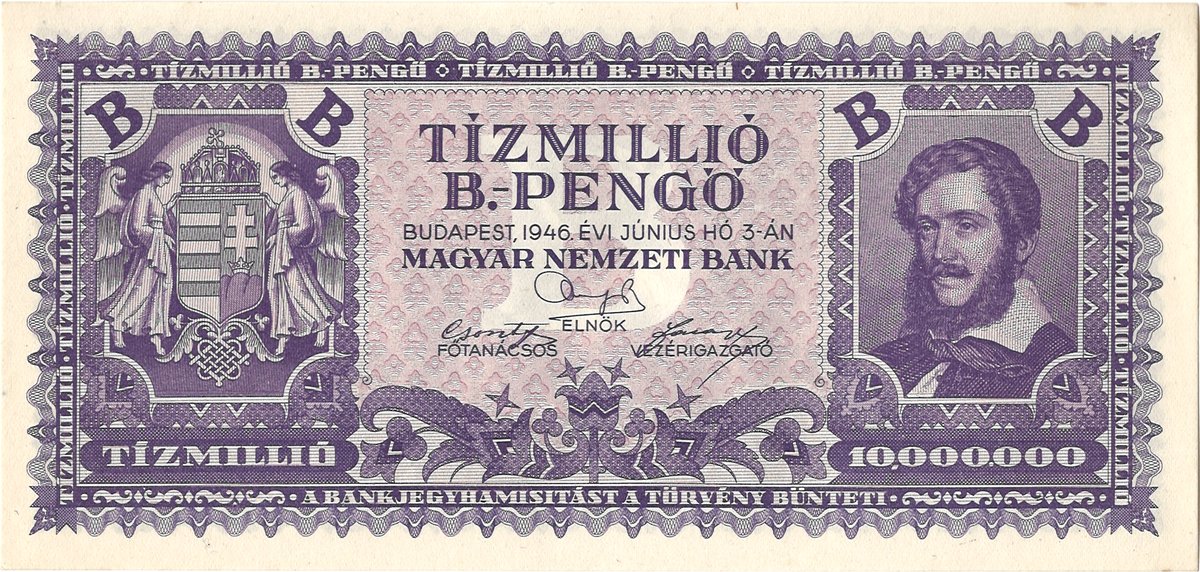
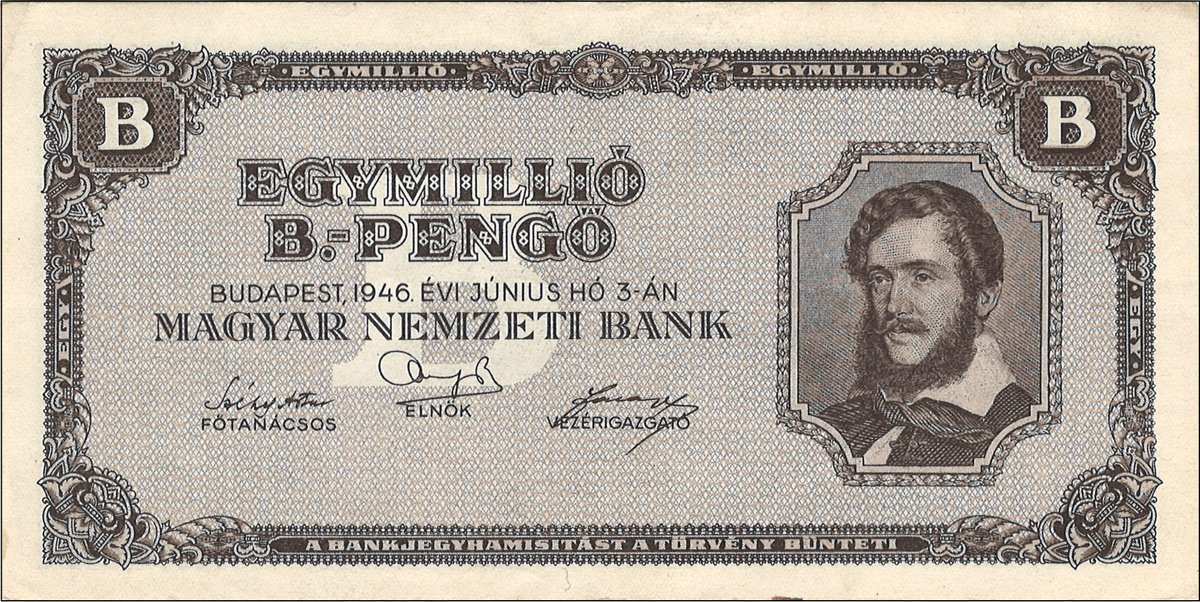
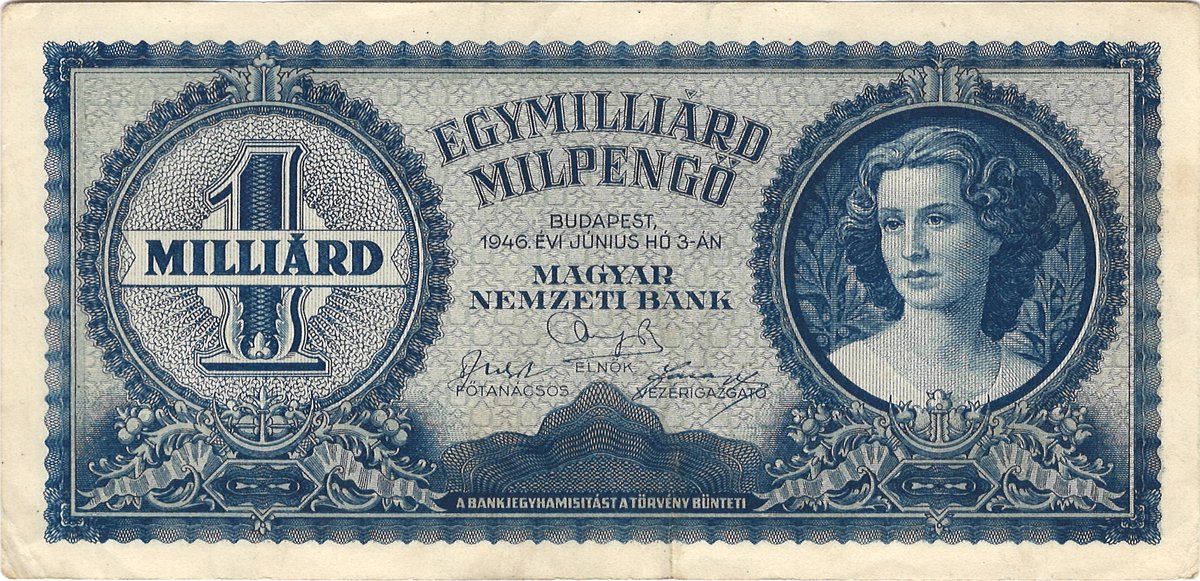
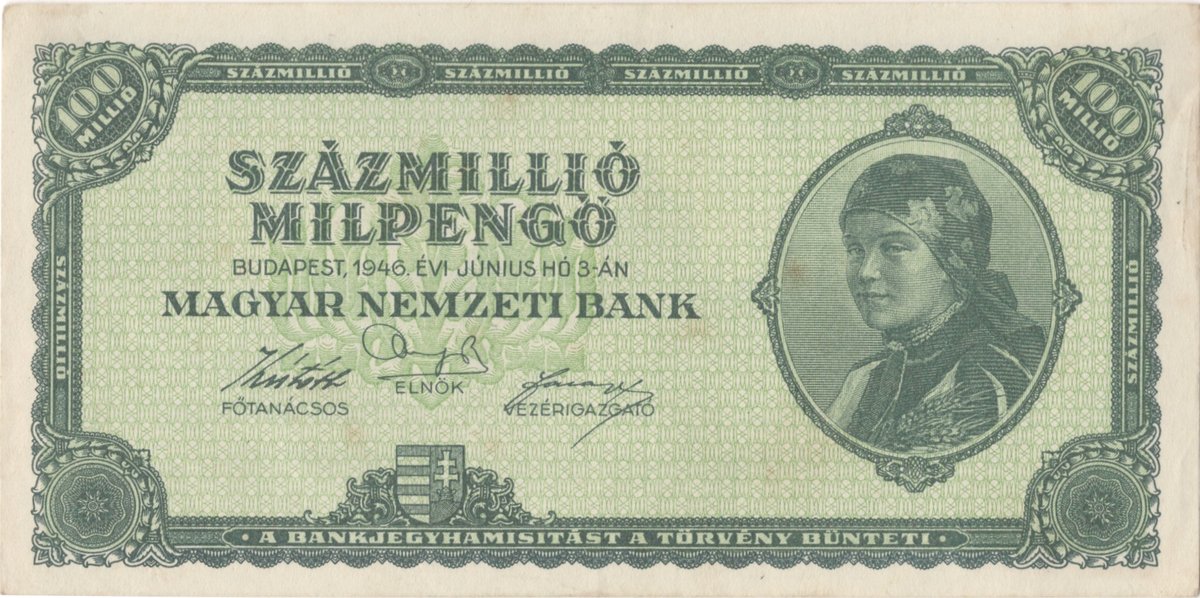
4banknotes in the collectionPengő

Currency reform: 1 forint = 4×10²⁹ pengő · Cause: War destruction, reparations, deficit paid by the central bank · Resolution: Forint (1 Aug 1946) with a balanced budget

In short

In July 1946 prices rose 4.19 × 10¹⁶ % in one month — they doubled every 15 hours (H&K). The pengő was replaced on 1 August 1946 by the forint, at 400 octillion (4 × 10²⁹) pengő to 1.

The curve

Pengő per 1 USD, logarithmic scale: each line up is many times the one below.

1,000 10 million 100 billion 10¹⁵ 10¹⁹ 10²³ 10²⁷ 10³¹ 1946 1945-08: 1,320 1945-10: 8,200 1945-12: 128,000 1946-05: 4.2×10¹⁶ 1946-07: 4.6×10³⁰ Worst month

Worst hyperinflation on record: prices rose 4.19×10¹⁶ % in July 1946 and doubled every 15 hours (Hanke & Krus). The forint replaced the pengő on 1 August 1946 at 4×10²⁹ pengő to 1. Source: Wikipedia, "Hungarian pengő" (rates of 31 Aug, 31 Oct, 31 Dec 1945, 31 May and 10 Jul 1946).

What happened

The events in order, with the banknotes at the date on them.

Aug 1945
Monthly inflation crosses 50% (H&K start); 1,320 pengő per dollar.
Dec 1945
128,000 pengő per dollar.
1 Jan 1946
The adópengő ("tax pengő") is introduced as an indexed unit of account for taxes and bank deposits, re-pegged to the pengő daily.
31 May 1946
4.2 × 10¹⁶ pengő per dollar.
dated
3 Jun 1946
10 million b.-pengő = 10¹⁹ pengő (3 Jun 1946)
dated
3 Jun 1946
1 million b.-pengő = 10¹⁸ pengő (3 Jun 1946)
dated
3 Jun 1946
1 billion milpengő = 10¹⁵ pengő (3 Jun 1946)
dated
3 Jun 1946
100 million milpengő = 10¹⁴ pengő (3 Jun 1946)
Jul 1946
Peak: 4.19 × 10¹⁶ % in the month, prices doubling every 15 hours (H&K); 4.6 × 10³⁰ pengő per dollar on 10 July.
9 Jul 1946
Adópengő tax bills become legal tender.
1 Aug 1946
The forint replaces the pengő at 4 × 10²⁹ to 1.
Context: why it happened

  • Occupation and reparations. The Soviet army lived off the country, and the armistice imposed reparations to the USSR, Czechoslovakia and Yugoslavia.
  • Deficit financed by the central bank. With almost no tax base, the government paid with new money; the National Bank lent freely to the state and to firms.

Life during it

  • Prices were posted and changed during the day; at one stage the pengő lost 90% of its value in about four days (Wikipedia).
  • Money was swept off the streets as worthless; people traded in goods, foreign currency and gold.
  • Indexation (the adópengő) protected tax receipts and deposits for a while — then itself hyperinflated, because it was still printed to pay the state.

How it ended

Prices stabilised immediately and the forint held its value for years.

Consequences & lessons

  • Indexing (adópengő) does not stop inflation; it only moves who bears it, until the indexed unit is printed too.
  • Even the worst hyperinflation in history ended overnight once the new unit was limited and the state stopped paying with it.

The banknotes

The data

Savings worth $1,000 in August 1945, kept in Pengő, were worth $0 in July 1946.

figurevaluesource
Hyperinflation (≥ 50%/month)Aug 1945 – Jul 1946H&K
Peak monthJuly 1946H&K
Peak monthly inflation4.19 × 10¹⁶ % (41.9 quadrillion %)H&K
Doubling time at peak15.0 hoursH&K
Pengő per USD, 31 Aug 19451,320Wikipedia (pengő)
Pengő per USD, 31 Oct 19458,200Wikipedia (pengő)
Pengő per USD, 31 Dec 1945128,000Wikipedia (pengő)
Pengő per USD, 31 May 19464.2 × 10¹⁶Wikipedia (pengő)
Pengő per USD, 10 Jul 19464.6 × 10³⁰Wikipedia (pengő)
Largest note issued100 million b.-pengő = 10²⁰ pengőWikipedia (pengő)
Largest note printed, never issued1 billion (10⁹) b.-pengő = 10²¹ pengőWikipedia (pengő)
Conversion1 forint = 4 × 10²⁹ pengő (1 Aug 1946)Wikipedia (pengő)
The series, point by point
Monthper $
1945-081,320
1945-108,200
1945-12128,000
1946-054.2×10¹⁶
1946-074.6×10³⁰
Cite this case
“Hungary 1945–1946”, Hyperinflation Archive, hyperinflation.rogzy.org/hungary-1945-1946/ (2026). Figures: Hanke & Krus (2012) and the sources listed below.

Sources

  1. Hanke & Krus (2012), World Hyperinflations, Cato WP no. 8 — dates, peak, doubling time.
  2. Wikipedia, "Hungarian pengő" — exchange rates, notes, adópengő, forint (read 2026-10-05): https://en.wikipedia.org/wiki/Hungarian_peng%C5%91
  3. Bomberger, W. A. & Makinen, G. E.

H&K = Hanke, S. H. & Krus, N. (2012), World Hyperinflations, Cato Institute Working Paper no. 8.

Further reading

More in the Library. Books, covers and descriptions from Plan B Network’s open educational content, CC BY-SA 4.0, with titles, names and punctuation corrected.