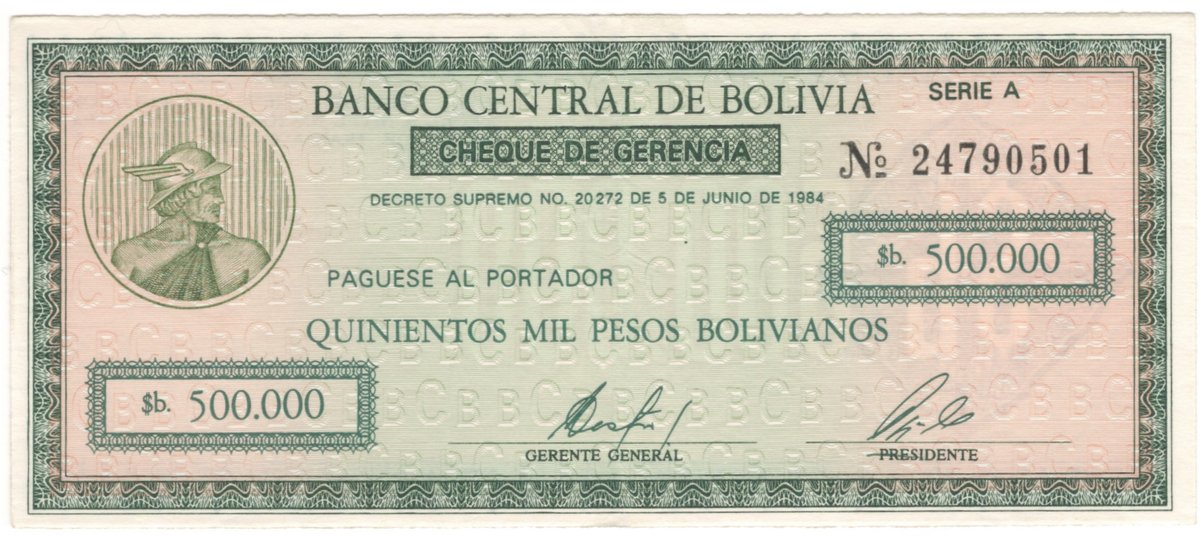
5 Jun 1984

Cases / Latin America's debt crisis / Bolivia
When the foreign credit of the 1970s stopped and tin prices fell, Bolivia's government kept spending and paid with the central bank.
Currency reform: 1 boliviano = 1,000,000 pesos (1987) · Cause: Debt crisis, a deficit paid by the central bank · Resolution: Decree 21060 (Aug 1985): free exchange rate, budget cuts
Hyperinflation ran from April 1984 to September 1985 and peaked at 183 % in February 1985, prices doubling every 20.3 days (H&K). The central bank could not print notes fast enough and issued bank cheques (cheques de gerencia) as cash. Decree 21060 of August 1985 (the "New Economic Policy") stopped it within weeks.
No exchange-rate chart for this case yet: no series we could source month by month. The figures that matter are in the text and the key figures below, each with its source.
The events in order, with the banknotes at the date on them.

A classic shock: an exchange rate set by the market, a budget balanced by cutting spending and raising state fuel prices, and the central bank stopped financing the state.
| figure | value | source |
|---|---|---|
| Hyperinflation (≥ 50%/month) | Apr 1984 – Sep 1985 | H&K |
| Peak month | February 1985 | H&K |
| Peak monthly inflation | 183 % | H&K |
| Doubling time at peak | 20.3 days | H&K |
| Pesos per USD (annual average) | 64.12 (1982) · 229.78 (1983) · 2,314 (1984) | Wikipedia (Bolivian peso) |
| Black-market rate, Sep 1985 | ≈ 1,000,000 pesos per USD | Wikipedia (Bolivian peso) |
| Free exchange rate | 29 Aug 1985 (an effective 95 % devaluation) | Wikipedia (Bolivian peso) |
| Emergency money | cheques de gerencia, up to 10,000,000 pesos (1985) | Wikipedia (Bolivian peso) |
| Boliviano | 1 Jan 1987, 1 boliviano = 1,000,000 pesos | Wikipedia (Bolivian peso) |
H&K = Hanke, S. H. & Krus, N. (2012), World Hyperinflations, Cato Institute Working Paper no. 8.