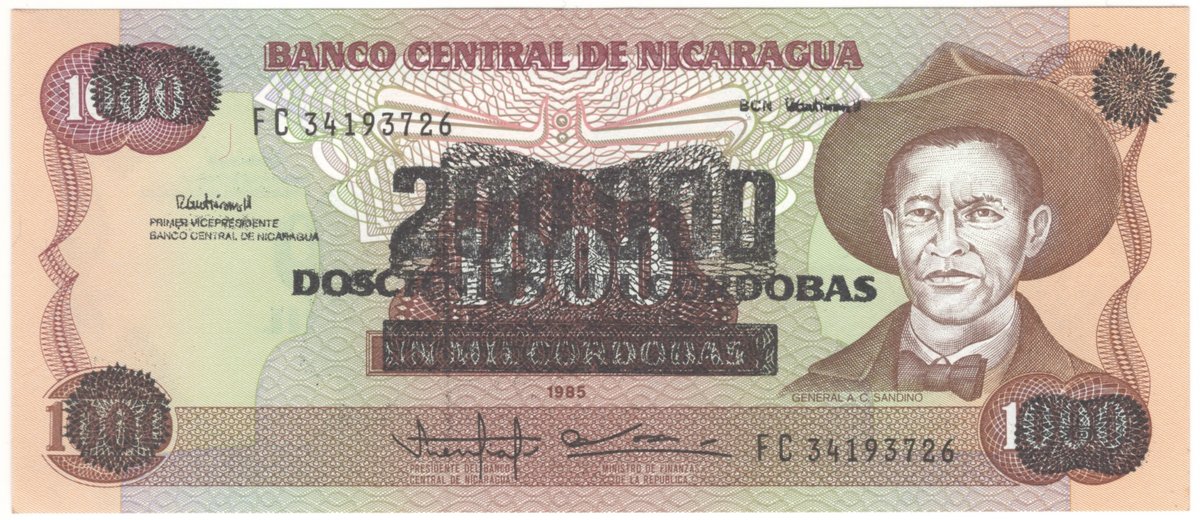
1985

Cases / Latin America's debt crisis / Nicaragua
During the Contra war and the US trade embargo, the Sandinista government financed defence and subsidies with the central bank.
Currency reform: 1 córdoba nuevo = 1,000 córdobas (1988) · Cause: Civil war, US embargo, a deficit paid by the central bank · Resolution: Peace, foreign aid, the dollar-linked córdoba oro
Hyperinflation lasted almost five years (H&K: June 1986 – March 1991), one of the longest on record. The worst month came at the very end: 261 % in March 1991, prices doubling every 16.4 days (H&K). A 1988 reform cut three zeros; within two years notes were overprinted up to a million córdobas. The dollar-linked córdoba oro ended it.
Córdobas (pre-1988) per 1 USD (córdoba nuevo converted back, ×1,000), logarithmic scale: each line up is many times the one below.
"Operación Berta" (14 Feb 1988) replaced 1,000 córdobas with 1 córdoba nuevo; later points are converted back into old córdobas. Hyperinflation ran from June 1986 to March 1991 and peaked at 261% in March 1991 (Hanke & Krus). Approximate series, kept for its shape; individual points are not sourced one by one. Source: Banco Central de Nicaragua.
The events in order, with the banknotes at the date on them.

| figure | value | source |
|---|---|---|
| Hyperinflation (≥ 50%/month) | Jun 1986 – Mar 1991 | H&K |
| Peak month | March 1991 | H&K |
| Peak monthly inflation | 261 % | H&K |
| Doubling time at peak | 16.4 days | H&K |
| Redenomination | 14 Feb 1988 ("Operación Berta"), 1 córdoba nuevo = 1,000 córdobas | Wikipedia (Nicaraguan córdoba) |
| Largest overprints | up to 1,000,000 córdobas (on the 1,000) | Wikipedia (Nicaraguan córdoba) |
| Month | old córdobas/USD |
|---|---|
| 1987-01 | 70 |
| 1987-06 | 1,000 |
| 1987-12 | 5,500 |
| 1988-02 | 10,000 |
| 1988-06 | 90,000 |
| 1988-12 | 920,000 |
| 1989-06 | 15 million |
| 1989-12 | 45 million |
| 1990-02 | 180 million |
| 1990-06 | 1.5 billion |
| 1990-12 | 3.2 billion |
H&K = Hanke, S. H. & Krus, N. (2012), World Hyperinflations, Cato Institute Working Paper no. 8.