1942

Cases / World War II / Philippines
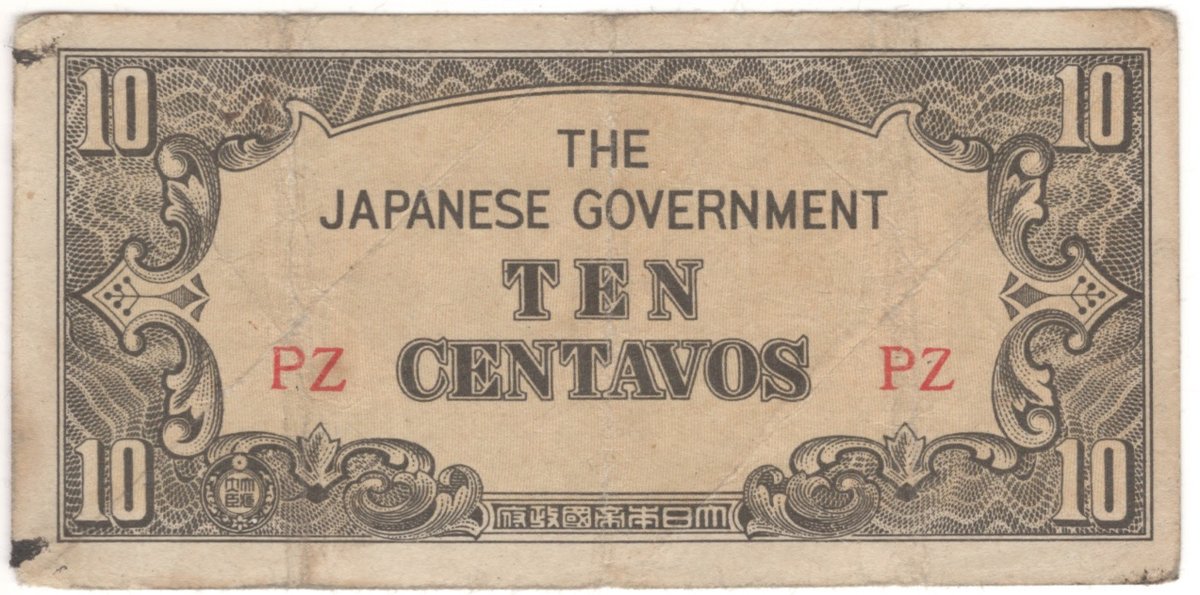
The Japanese occupiers paid for what they took with a peso they printed themselves, which Filipinos nicknamed "Mickey Mouse money".
Currency reform: Withdrawn at liberation (1945) · Cause: Occupation money printed by the Japanese army · Resolution: Liberation; the occupation peso became worthless
Hyperinflation was measured: 60 % in January 1944, prices doubling every 44.9 days (H&K, who call the currency "Japanese War Notes"). By 1944 a box of matches cost more than 100 of these pesos. At liberation the currency was withdrawn and worth nothing.
No exchange-rate chart for this case yet: no series we could source month by month. The figures that matter are in the text and the key figures below, each with its source.
The events in order, with the banknotes at the date on them.

The currency did not end through a reform: it ended with the army that issued it. Savings held in occupation pesos were simply lost.
| figure | value | source |
|---|---|---|
| Hyperinflation (≥ 50%/month) | Jan – Dec 1944 | H&K |
| Peak month | January 1944 | H&K |
| Peak monthly inflation | 60.0 % | H&K |
| Doubling time at peak | 44.9 days | H&K |
| Price example | a box of matches > 100 pesos (1944) | Wikipedia (Japanese government-issued Philippine peso) |
| Price example | 75 pesos (≈ US$35 of the time) for one duck egg | Wikipedia (same) |
| Largest note | 1,000 pesos (1945) | Wikipedia (same) |
H&K = Hanke, S. H. & Krus, N. (2012), World Hyperinflations, Cato Institute Working Paper no. 8.