Hyperinflation/Archive

Cases / After the Great War / Germany

Germany
1921–1923

The reference case. A lost war, reparations the state would not tax for, and a central bank that bought the government's bills without limit took the mark from 4.2 per dollar in 1914 to 4.2 trillion in November 1923.

29,500%prices in the worst monthOctober 1923
3.70 daysfor prices to doubleat the peak (Hanke & Krus)
Aug 1922 – Dec 1923above 50% a monththe hyperinflation itself
9banknotes in the collectionPapiermark

Currency reform: 1 Rentenmark = 1 trillion marks · Cause: Reparations and a deficit paid by the Reichsbank · Resolution: Rentenmark (Nov 1923), Reichsbank barred from lending to the state

In short

Prices peaked in October 1923, rising 29,500% in a single month and doubling every 3.70 days (H&K). It ended within weeks once the Reichsbank was barred from financing the state and a new unit, the Rentenmark, replaced the paper mark.

The curve

Marks per 1 USD, logarithmic scale: each line up is many times the one below. The small squares are the banknotes, at the month dated on them.

10 1,000 100,000 10 million 1 billion 100 billion 10 trillion 1921 1922 1923 1921-01: 64 1921-02: 62 1921-03: 63 1921-04: 64 1921-05: 62 1921-06: 70 1921-07: 77 1921-08: 100 1921-09: 110 1921-10: 150 1921-11: 263 1921-12: 191 1922-01: 192 1922-02: 208 1922-03: 285 1922-04: 291 1922-05: 290 1922-06: 317 1922-07: 493 1922-08: 1,134 1922-09: 1,465 1922-10: 3,180 1922-11: 7,183 1922-12: 7,589 1923-01: 17,792 1923-02: 27,918 1923-03: 21,190 1923-04: 24,475 1923-05: 47,670 1923-06: 109,966 1923-07: 353,412 1923-08: 4.62 million 1923-09: 98.9 million 1923-10: 25.3 billion 1923-11: 4.2 trillion Worst month

Monthly averages, except the last point: 4.2 trillion marks per dollar in November 1923 (Wikipedia). Peak monthly inflation 29,500% in October 1923 (Hanke & Krus). The Rentenmark replaced 1 trillion paper marks. Source: Statistisches Reichsamt, Historical Statistics of Germany.

What happened

The events in order, with the banknotes at the date on them.

1914–1918
War financed by debt; 4.2 → 7.9 marks per dollar.
May 1921
London Schedule: 132 bn gold marks of reparations.
mid-1922
320 marks per dollar; August 1922 inflation crosses 50%/month (H&K start).
dated
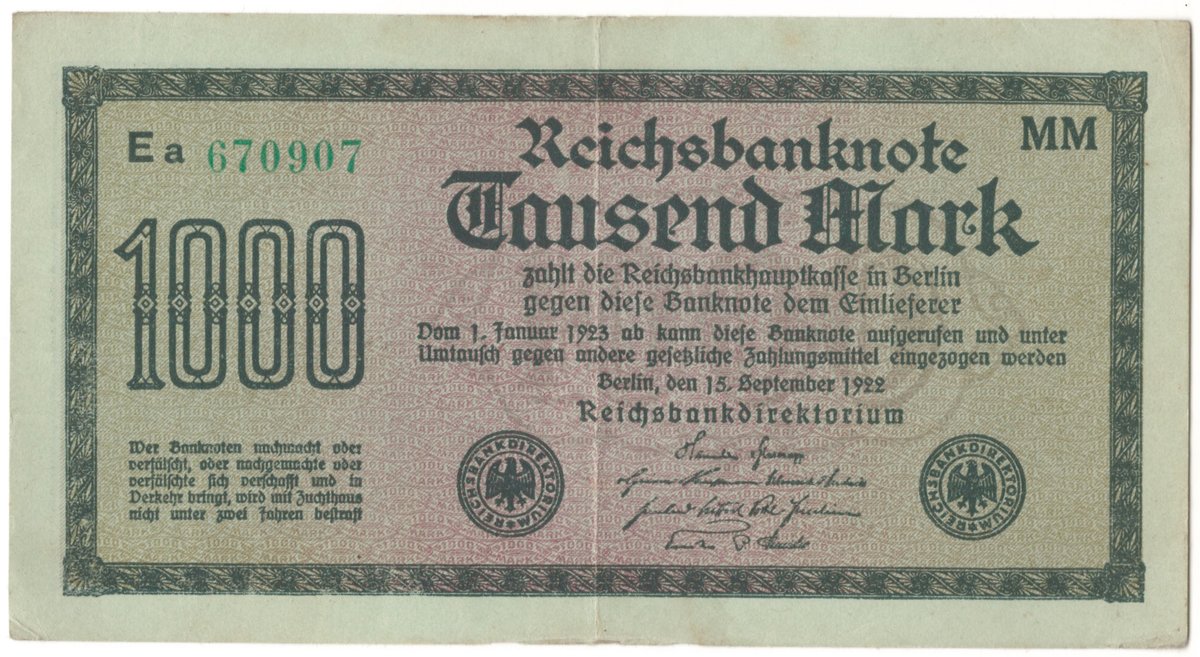
15 Sep 1922
1,000 marks (15 Sep 1922)
1,000 marks (15 Sep 1922)worth ≈ $0.68 that month
December 1922
7,400 marks per dollar.
dated
1923
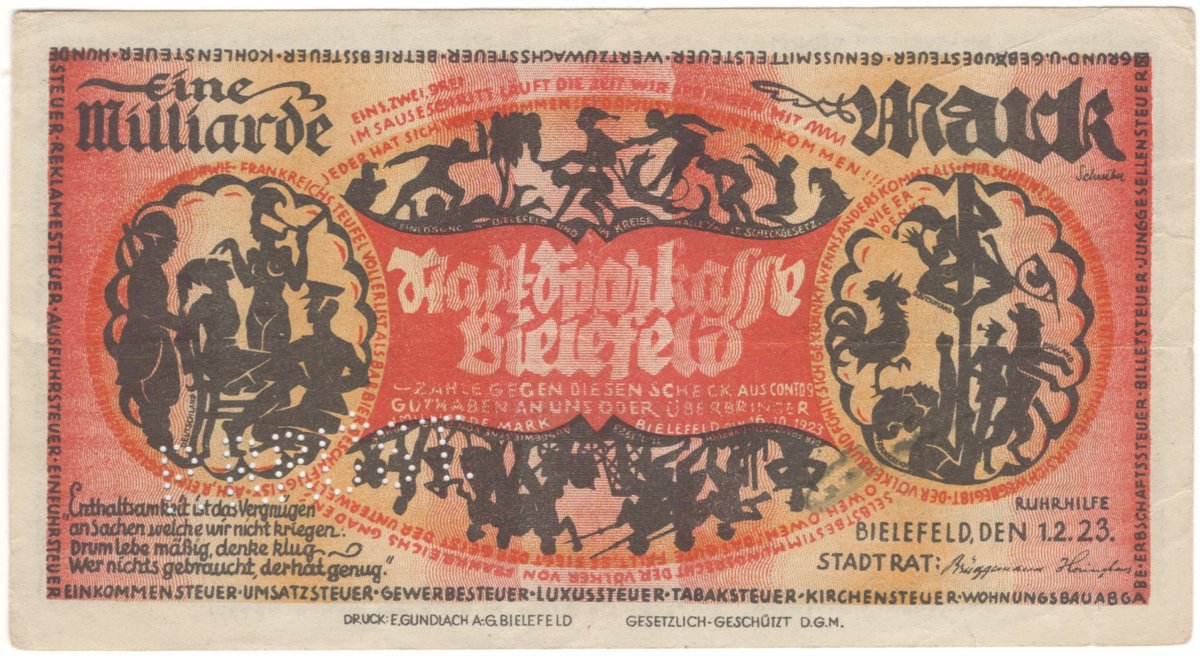
1 billion marks, emergency money (Notgeld), Bielefeld (1923)
January 1923
Occupation of the Ruhr; passive resistance financed by the press.
dated
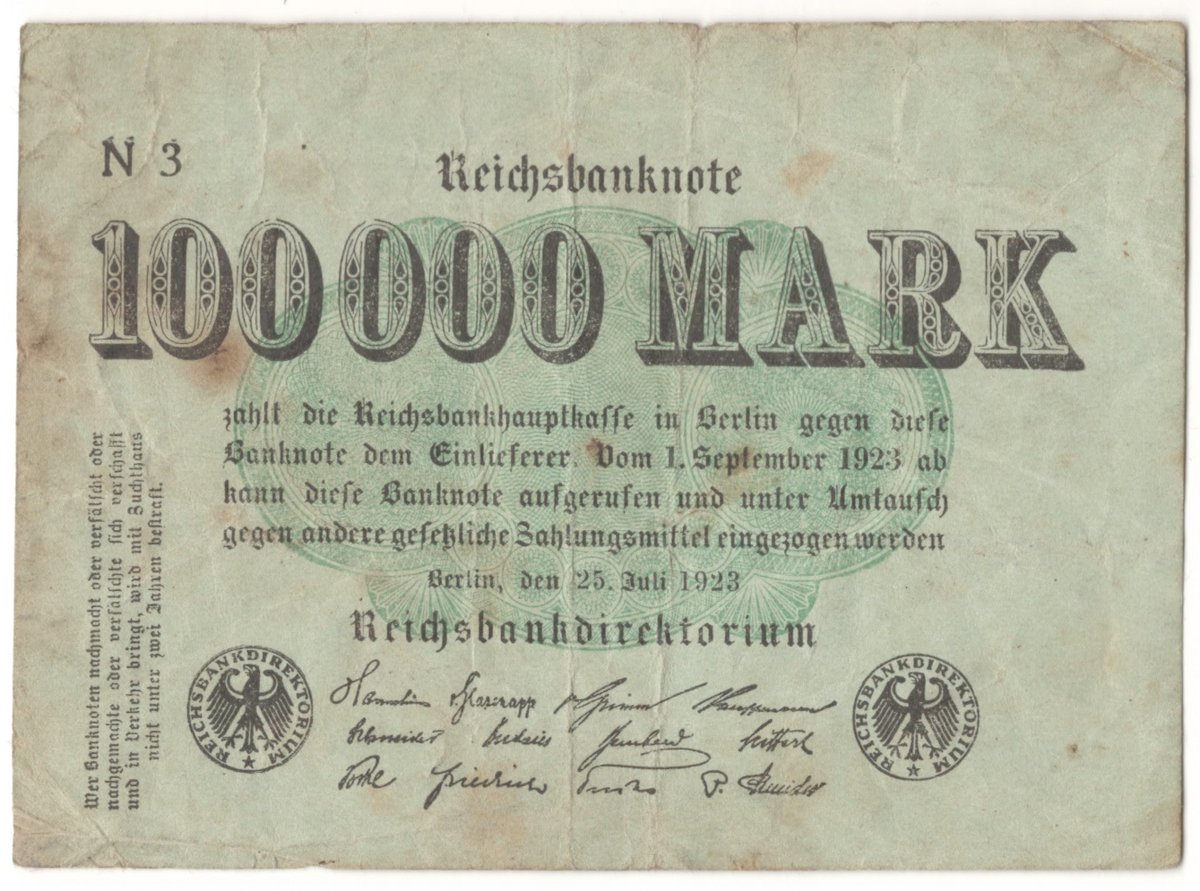
25 Jul 1923
100,000 marks (25 Jul 1923)
100,000 marks (25 Jul 1923)worth ≈ $0.28 that month
August 1923
Helfferich proposes a rye-backed "Roggenmark", the idea behind the Rentenmark.
dated
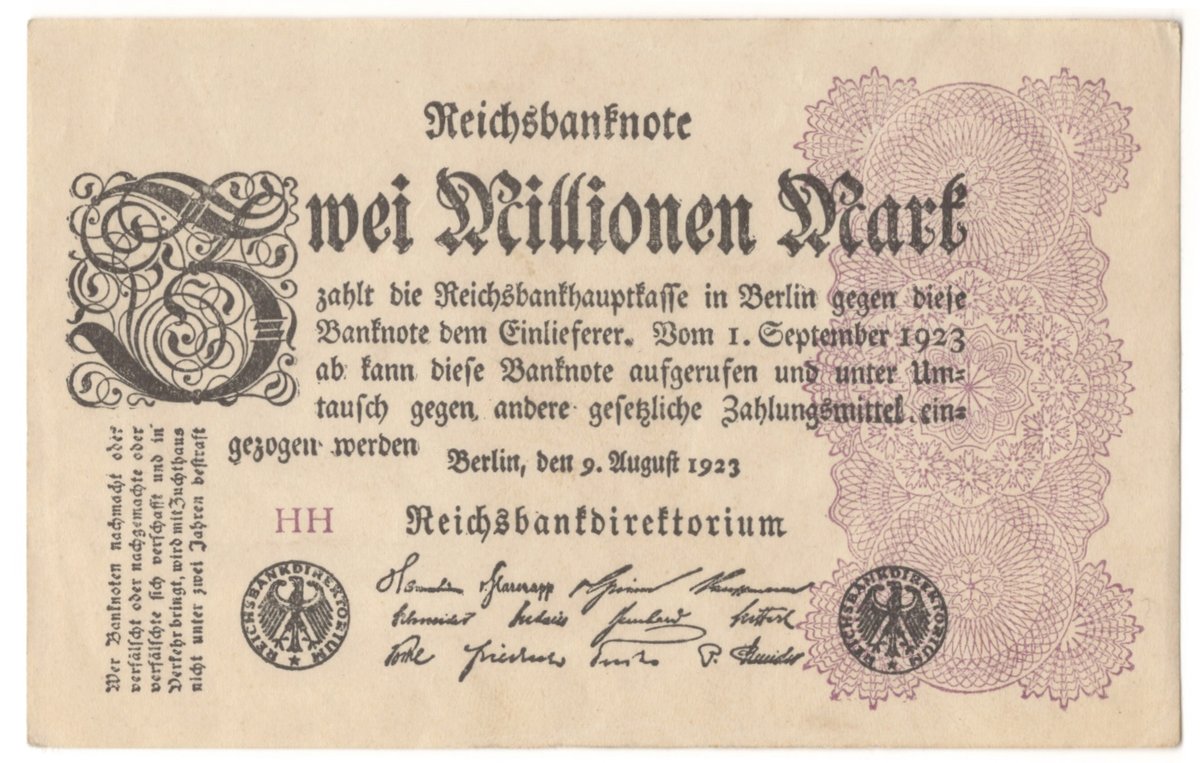
9 Aug 1923
2 million marks (9 Aug 1923)
2 million marks (9 Aug 1923)worth ≈ $0.43 that month
dated
Sep 1923
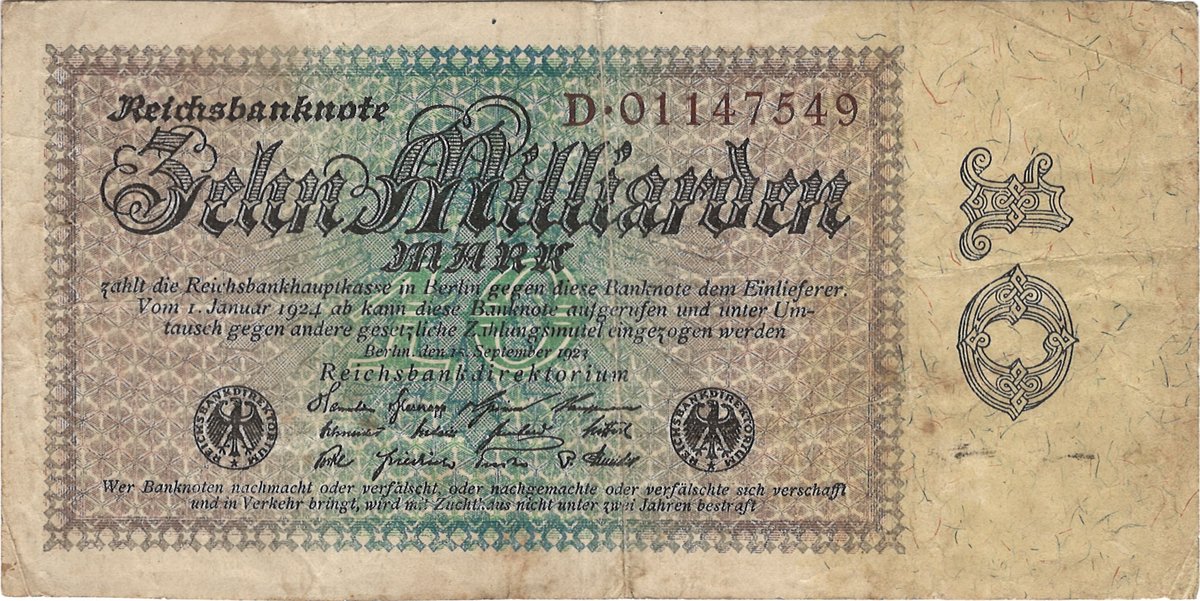
10 billion marks (Sep 1923)
10 billion marks (Sep 1923)worth ≈ $101 that month
dated
1 Sep 1923
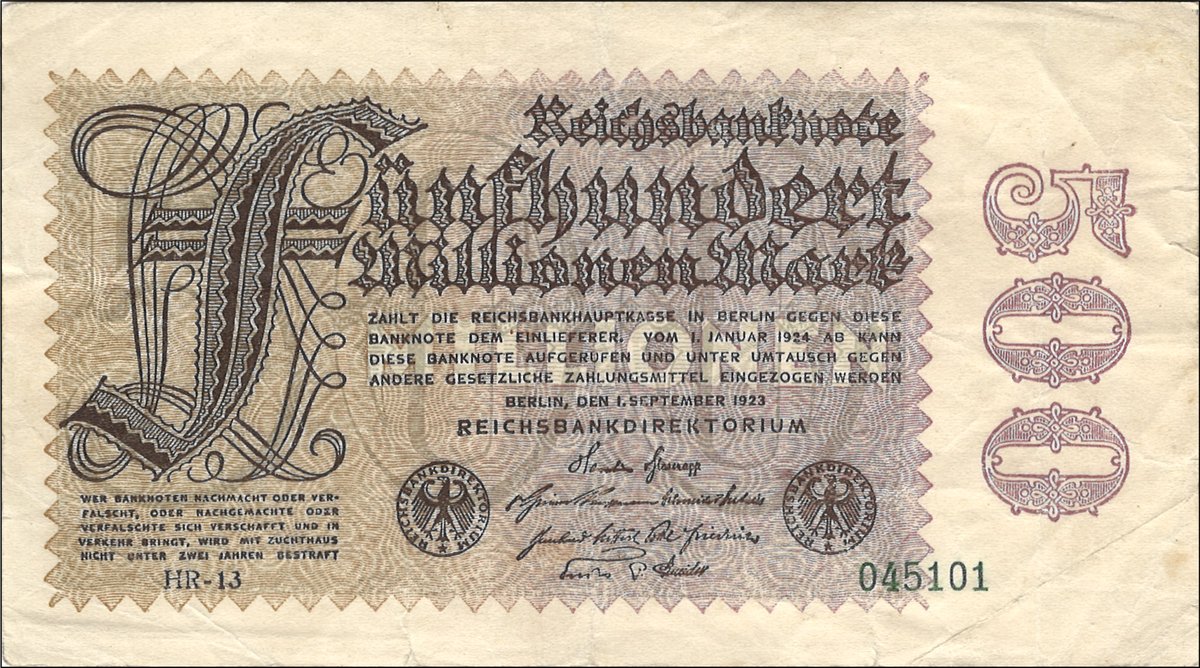
500 million marks (1 Sep 1923)
500 million marks (1 Sep 1923)worth ≈ $5.06 that month
dated
1 Sep 1923
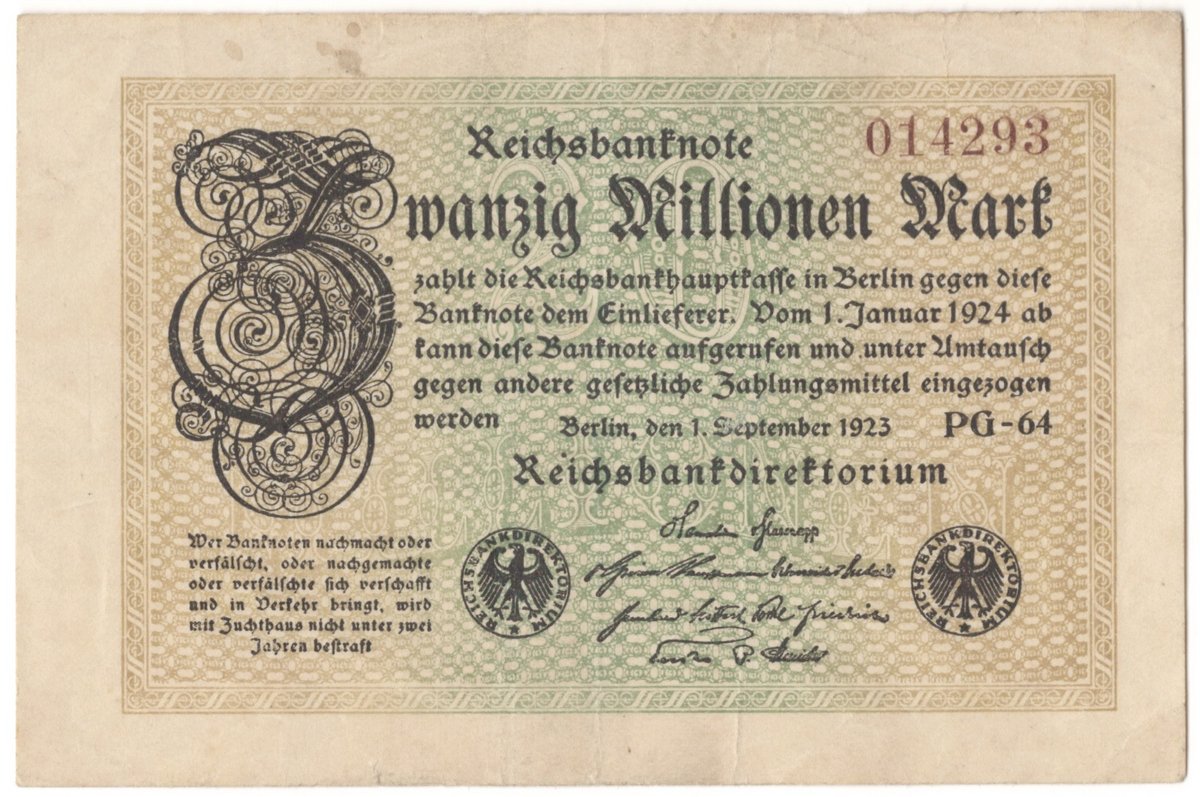
20 million marks (1 Sep 1923)
20 million marks (1 Sep 1923)worth ≈ $0.20 that month
dated
1 Sep 1923
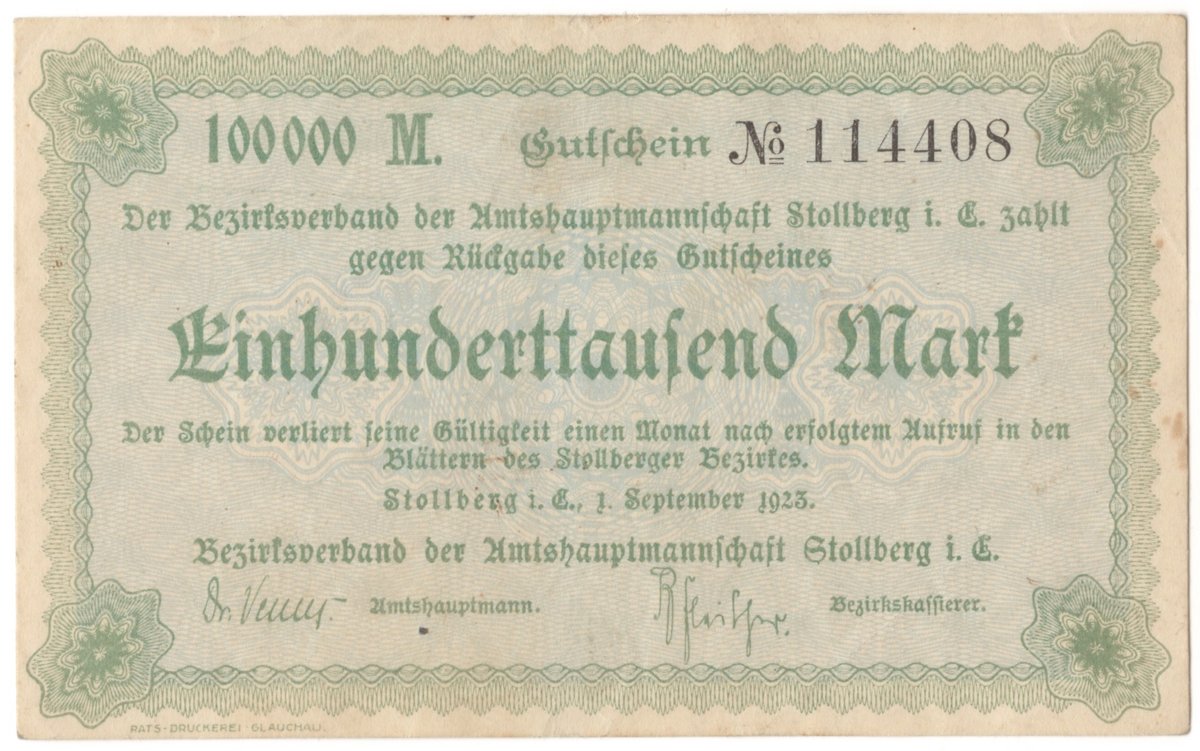
100,000 marks, emergency money (Notgeld), Stollberg (1 Sep 1923)
100,000 marks, emergency money (Notgeld), Stollberg (1 Sep 1923)worth ≈ $0.001011531459 that month
October 1923
Peak: +29,500% in the month, prices doubling every 3.70 days (H&K).
dated
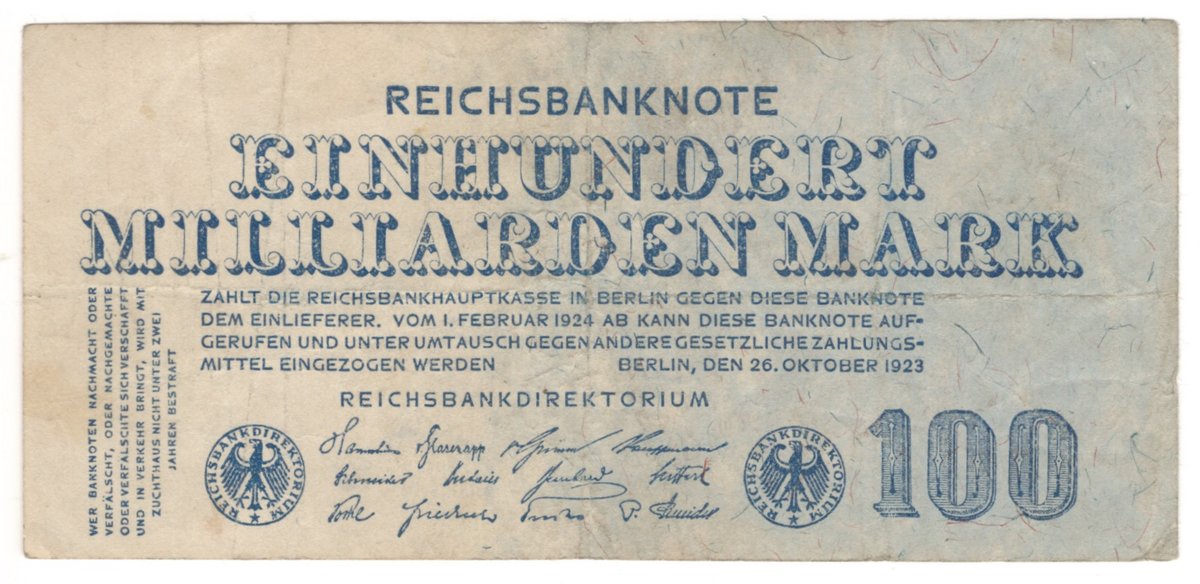
26 Oct 1923
100 billion marks (26 Oct 1923)
100 billion marks (26 Oct 1923)worth ≈ $3.96 that month
12 November 1923
Hjalmar Schacht becomes currency commissioner; the Reichsbank may no longer discount Treasury bills.
16 November 1923
The Rentenmark is introduced; twelve zeros cut.
20 November 1923
Reichsbank president Rudolf Havenstein dies; the dollar is at ≈ 4.2 trillion.
1924
Dawes Plan restarts reparations on a payable schedule; 30 August 1924 monetary law: 1 trillion paper marks = 1 Reichsmark (= 1 Rentenmark).
Context: why it happened

  • War finance. Germany paid for 1914–18 with borrowing and money, not taxes, expecting the loser to pay. The mark had already lost most of its value by 1919 (48/USD).
  • Reparations. The London Schedule (May 1921) set 132 billion gold marks. Payments in gold or foreign currency meant selling marks for dollars, which pushed the mark down.
  • The central bank as the Treasury's buyer. The Reichsbank discounted government Treasury bills without limit; each bill became new paper marks. This is the mechanism, and stopping it is what ended the inflation (see The end).
  • The Ruhr. In January 1923 French and Belgian troops occupied the Ruhr after a default on deliveries. The government backed passive resistance by paying idle workers — with printed money — while losing the output of its industrial heart. 1923 is when inflation became hyperinflation.

Life during it

  • Workers were paid daily, then twice a day, and spent the money within hours.
  • A Berlin loaf went from about 160 marks at the end of 1922 to 200 billion marks in late 1923.
  • Savings, pensions, life insurance and war bonds — the middle class's wealth — were wiped out; debtors (including the state and anyone with a mortgage) were freed of their debts.
  • Towns and firms printed their own emergency money (Notgeld) when the Reichsbank could not keep up.

How it ended

Three things at once, in November 1923: (1) the Reichsbank stopped discounting Treasury bills — the ban, which is the reform; (2) a new unit, the Rentenmark, nominally backed by a mortgage on German land and industry, issued in a strictly limited amount; (3) budget cuts. The price level held from late November. The Dawes Plan (1924) made reparations payable and brought foreign loans; the Reichsmark replaced both marks from August 1924.

Consequences & lessons

  • The press is the mechanism; the deficit financed by the central bank is the cause.
  • The Rentenmark's "backing" could never be redeemed — its strength was the limit on its quantity and the ban on financing the state, i.e. credibility, not collateral.
  • The fear of 1923 shaped German monetary policy for a century (Bundesbank, then the ECB mandate).

The banknotes

The data

Savings worth $1,000 in January 1921, kept in Papiermark, were worth $0.000000015238 in November 1923.

figurevaluesource
Hyperinflation (≥ 50%/month)Aug 1922 – Dec 1923, 16 monthsH&K
Peak monthOctober 1923H&K
Peak monthly inflation29,500%H&K
Doubling time at peak3.70 daysH&K
Marks per USD, 1914–19184.2 to 7.9Wikipedia (Weimar)
Marks per USD, late 191948Wikipedia (Weimar)
Marks per USD, mid-1922320Wikipedia (Weimar)
Marks per USD, Dec 19227,400Wikipedia (Weimar)
Marks per USD, Nov 19234,210,500,000,000 (≈ 4.2 trillion)Wikipedia (Weimar)
Loaf of bread, Berlin≈ 160 marks end 1922 → 200 billion marks late 1923Wikipedia (Weimar)
Reparations (London Schedule, May 1921)132 billion gold marks, of which 50 bn in A and B bondsWikipedia (Weimar)
Conversion1 Rentenmark = 1 trillion (10¹²) paper marks — twelve zerosWikipedia (Weimar)
The series, point by point
Monthper $
1921-0164
1921-0262
1921-0363
1921-0464
1921-0562
1921-0670
1921-0777
1921-08100
1921-09110
1921-10150
1921-11263
1921-12191
1922-01192
1922-02208
1922-03285
1922-04291
1922-05290
1922-06317
1922-07493
1922-081,134
1922-091,465
1922-103,180
1922-117,183
1922-127,589
1923-0117,792
1923-0227,918
1923-0321,190
1923-0424,475
1923-0547,670
1923-06109,966
1923-07353,412
1923-084.62 million
1923-0998.9 million
1923-1025.3 billion
1923-114.2 trillion
Cite this case
“Germany 1921–1923”, Hyperinflation Archive, hyperinflation.rogzy.org/germany-1921-1923/ (2026). Figures: Hanke & Krus (2012) and the sources listed below.

Sources

  1. Hanke & Krus (2012), World Hyperinflations, Cato WP no. 8 — dates, peak, doubling time.
  2. Wikipedia, "Hyperinflation in the Weimar Republic" — rates, Ruhr, Rentenmark, Schacht, Havenstein, bread, Reichsmark (read 2026-10-05): https://en.wikipedia.org/wiki/Hyperinflation_in_the_Weimar_Republic
  3. Fergusson, A. (1975), When Money Dies.
  4. Bresciani-Turroni, C. (1931; Eng. tr. 1937), The Economics of Inflation.
  5. Parsson, J. O. (1974), Dying of Money.

H&K = Hanke, S. H. & Krus, N. (2012), World Hyperinflations, Cato Institute Working Paper no. 8.

Books

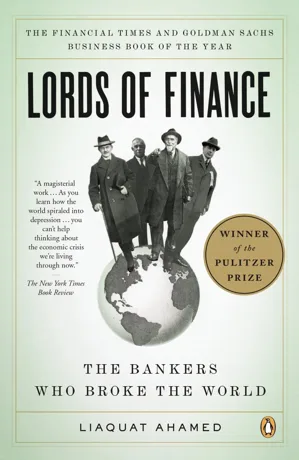
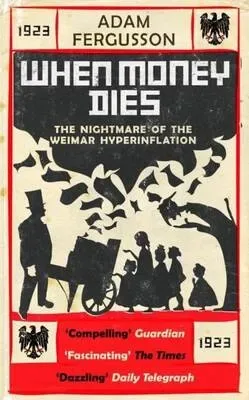
  • When Money Dies, Adam Fergusson (1975). The nightmare of deficit spending, devaluation, and hyperinflation in Weimar Germany.
  • Dying of Money, Jens O. Parsson (1974). Lessons of the great German and American inflations.
  • The Economics of Inflation, Costantino Bresciani-Turroni (1937). A comprehensive study of the German currency depreciation after World War I (Italian original 1931, English translation 1937).

Further reading

More in the Library. Books, covers and descriptions from Plan B Network’s open educational content, CC BY-SA 4.0, with titles, names and punctuation corrected.