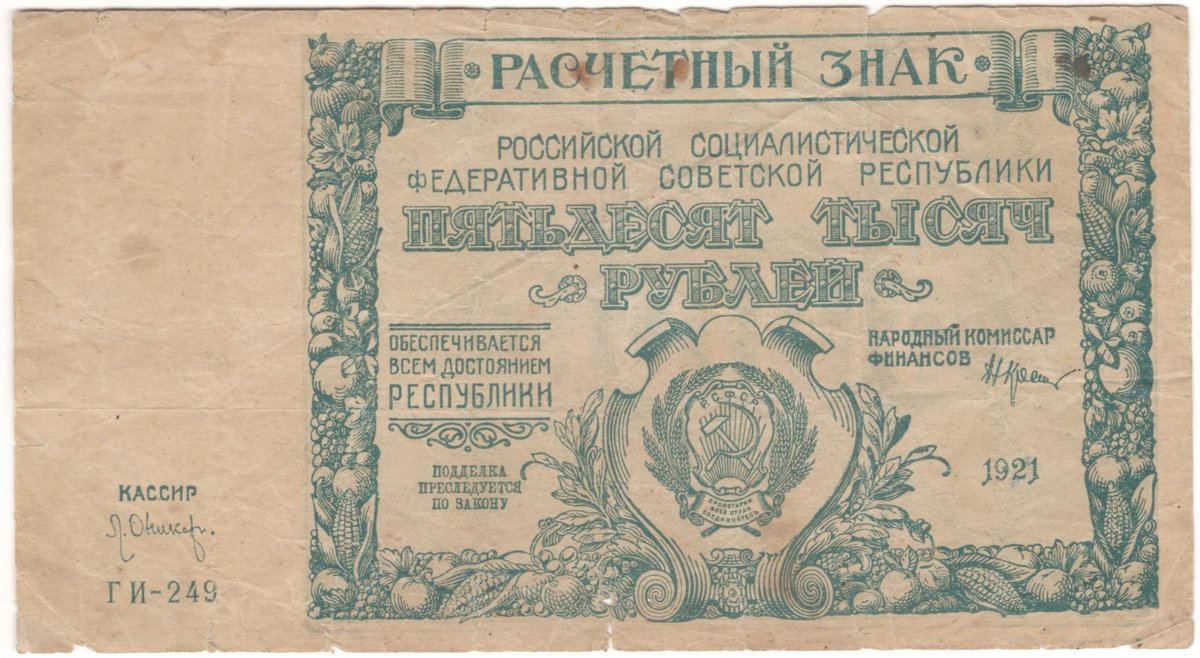
1921

Cases / After the Great War / Soviet Russia
The Bolsheviks financed civil war and the state with paper money, and some of them saw that as a way to abolish money altogether ("war communism").
Currency reform: 1 gold ruble = 50 billion paper rubles · Cause: Civil war and "war communism" paid with paper money · Resolution: The gold-backed chervonets ran alongside, then replaced the paper ruble (1924)
Hyperinflation in H&K's table runs from January 1922 to February 1924, peaking at 212 % in February 1924 (H&K). The way out was unusual: a new, gold-backed banknote, the chervonets (1922), circulated beside the collapsing paper ruble until the 1924 reform retired the paper. One gold ruble of 1924 was worth 50 billion rubles of the first Soviet issue.
No exchange-rate chart for this case yet: no series we could source month by month. The figures that matter are in the text and the key figures below, each with its source.
The events in order, with the banknotes at the date on them.

Two currencies ran side by side: people and firms moved to the chervonets, which was backed by gold and issued in limited amounts, while the paper ruble paid what remained of the deficit and collapsed.
| figure | value | source |
|---|---|---|
| Hyperinflation (≥ 50%/month) | Jan 1922 – Feb 1924 | H&K |
| Peak month | February 1924 | H&K |
| Peak monthly inflation | 212 % | H&K |
| Notes | RSFSR notes 1919–1921 up to 100,000 rubles; treasury certificates up to 10,000,000 | Wikipedia (Soviet ruble) |
| Chervonets | 10 rubles = 8.602 g of 90 % fine gold (then US$5.14) | Wikipedia (Soviet ruble) |
| 1923 ruble | = 1,000,000 paper rubles of 1917–1922 | Wikipedia (Soviet ruble) |
| 1924 gold ruble | = 50,000 rubles of 1923 = 50,000,000,000 rubles of the first issue | Wikipedia (Soviet ruble) |
H&K = Hanke, S. H. & Krus, N. (2012), World Hyperinflations, Cato Institute Working Paper no. 8.