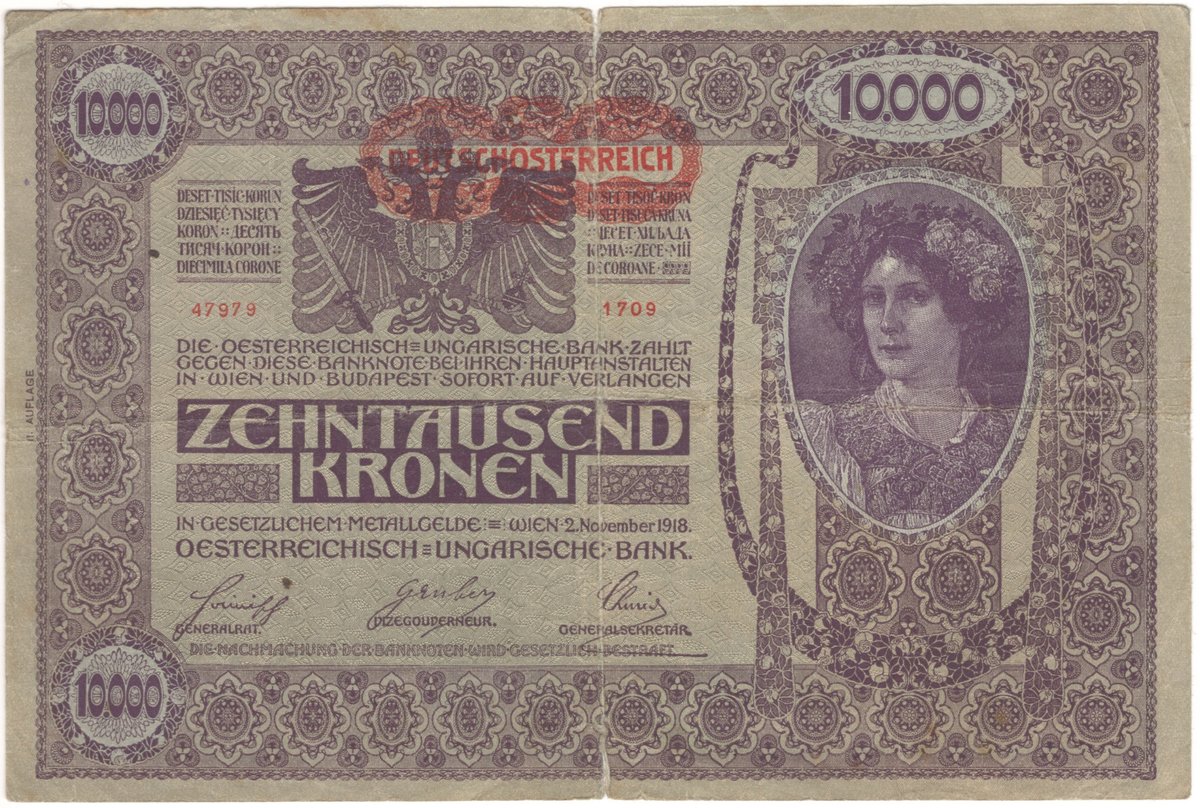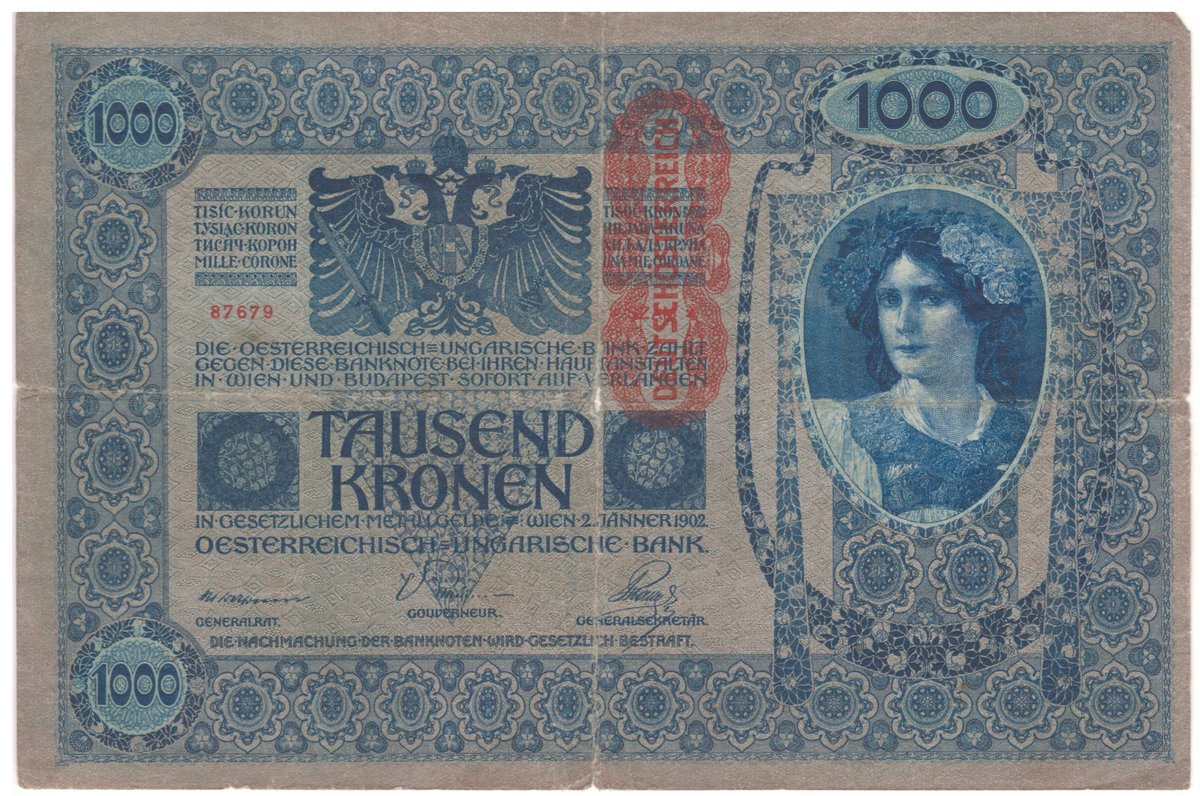
1902

1918

Cases / After the Great War / Austria
After 1918, Austria was a small country left with the capital of a large empire, cut off from the farmland and coal it used to rely on, and it ran its budget on the printing press.
Currency reform: 1 schilling = 10,000 kronen · Cause: Post-war collapse, a deficit paid with new money · Resolution: League of Nations loan (Oct 1922) with budget control; schilling (1924)
Inflation passed 50 % a month from October 1921. It peaked in August 1922 at 129 % in the month, with prices doubling every 25.5 days (H&K). By then, consumer prices were 14,000 times their pre-war level. A League of Nations loan in October 1922, conditional on budget control, stopped it within weeks.
Kronen per 1 USD, logarithmic scale: each line up is many times the one below.
Peak monthly inflation 129% in August 1922 (Hanke & Krus); prices were then 14,000 times their pre-war level. A League of Nations loan (Oct 1922) stabilised the krone at 14,400 paper kronen per gold krone; the schilling (10,000 kronen) followed. Approximate series, kept for its shape; individual points are not sourced one by one. Source: Oesterreichische Nationalbank, ECAEF - Austrian Hyperinflation After WWI.
The events in order, with the banknotes at the date on them.


Stopping the inflation needed two things at once: an outside lender that controlled the budget, and a central bank that was no longer allowed to finance the state. The krone stopped falling as soon as the loan was announced, before any money arrived, because expectations turned.
| figure | value | source |
|---|---|---|
| Hyperinflation (≥ 50%/month) | Oct 1921 – Sep 1922 | H&K |
| Peak month | August 1922 | H&K |
| Peak monthly inflation | 129 % | H&K |
| Doubling time at peak | 25.5 days | H&K |
| Prices, Aug 1922 vs pre-war | × 14,000 | Wikipedia (Austro-Hungarian krone) |
| Kronen per USD | 6.50 (1915) · 16.1 (Jan 1919) | Wikipedia (Austro-Hungarian krone) |
| Money supply | 12 → 30 billion K (1920), ≈ 147 billion K (end 1921) | Wikipedia (Austro-Hungarian krone) |
| League of Nations loan | 650 million gold kronen (Oct 1922) | Wikipedia (Austro-Hungarian krone) |
| Stabilisation ratio | 14,400 paper kronen = 1 gold krone | Wikipedia (Austro-Hungarian krone) |
| Largest note | 500,000 kronen (1922) | Wikipedia (Austro-Hungarian krone) |
| Schilling | 1 S = 10,000 K (law of 20 Dec 1924) | Wikipedia (Austro-Hungarian krone) |
| Month | per $ |
|---|---|
| 1919-01 | 16 |
| 1919-06 | 30 |
| 1919-12 | 105 |
| 1920-01 | 140 |
| 1920-06 | 180 |
| 1920-12 | 280 |
| 1921-01 | 310 |
| 1921-06 | 595 |
| 1921-08 | 1,240 |
| 1921-10 | 3,300 |
| 1921-12 | 5,275 |
| 1922-01 | 6,100 |
| 1922-03 | 8,500 |
| 1922-05 | 14,500 |
| 1922-06 | 22,500 |
| 1922-07 | 39,000 |
| 1922-08 | 77,500 |
| 1922-09 | 74,000 |
| 1922-10 | 71,000 |
| 1923-05 | 70,800 |
H&K = Hanke, S. H. & Krus, N. (2012), World Hyperinflations, Cato Institute Working Paper no. 8.
More in the Library. Books, covers and descriptions from Plan B Network’s open educational content, CC BY-SA 4.0, with titles, names and punctuation corrected.

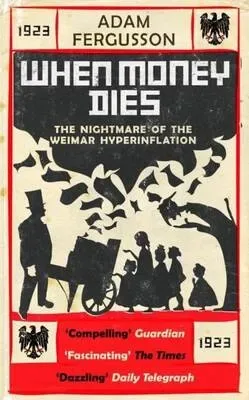
Adam Fergusson · 1975 · intermediate
When Money Dies by Adam Fergusson is a book that explores the hyperinflation that occurred in Germany during the early 1920s, in the aftermath of World War I. The book provides a detailed account of the social and economic consequences of hyperinflation and how it led to the rise of the Nazi party. Fergusson also examines how the events in Germany influenced economic policies in other countries and how they dealt with their own economic problems. The book offers a cautionary tale of the dangers of inflation and the importance of sound monetary policies.
Cases on this site: Germany 1921, Austria 1921