Hyperinflation/Archive

Cases / The 21st century / Zimbabwe

Zimbabwe
2007–2009

A farm-export economy whose output collapsed after the seizure of commercial farms, governed by a state that financed itself — and its war in the Congo — through its central bank.

79.6 billion %prices in the worst monthmid-November 2008
24.7 hoursfor prices to doubleat the peak (Hanke & Krus)
Mar 2007 – mid-Nov 2008above 50% a monththe hyperinflation itself
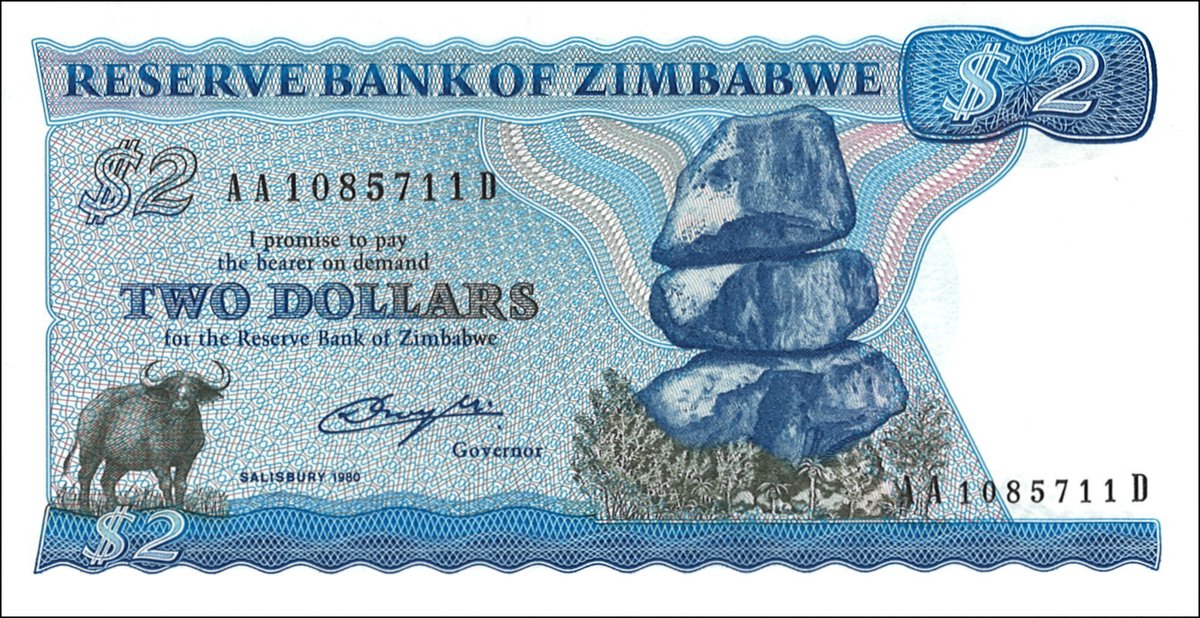
9banknotes in the collectionZimbabwean Dollar

Currency reform: 3, then 10, then 12 zeros removed · Cause: Farm collapse, a deficit paid by the Reserve Bank · Resolution: Currency abandoned for the US dollar and others (2009)

In short

Prices peaked in mid-November 2008, rising 79.6 billion % (7.96 × 10¹⁰ %) in one month and doubling every 24.7 hours (H&K, implied from the parallel rate). Twenty-five zeros were cut in three redenominations; in April 2009 the country gave up its own currency and used the US dollar and the rand.

The curve

Zimbabwe dollars per 1 USD (approximate), logarithmic scale: each line up is many times the one below. The small squares are the banknotes, at the month dated on them.

10,000 10 million 10 billion 10 trillion 10¹⁶ 10¹⁹ 2007 2008 2007-01: 30,000 2007-03: 120,000 2007-06: 350,000 2007-09: 750,000 2007-12: 2 million 2008-01: 4.5 million 2008-03: 25 million 2008-05: 200 million 2008-07: 10 billion 2008-08: 100 billion 2008-09: 1 trillion 2008-10: 100 trillion 2008-11: 2.6×10¹⁸ Worst month

Peak 79.6 billion percent in mid-November 2008, prices doubling every 24.7 hours (Hanke & Krus). Zeros removed: 3 (2006), 10 (2008), 12 (2009); the currency was abandoned in April 2009. Approximate series, kept for its shape; individual points are not sourced one by one. Source: Reserve Bank of Zimbabwe, Cato Institute - On the Measurement of Zimbabwe's Hyperinflation, Hanke & Kwok (2009).

What happened

The events in order, with the banknotes at the date on them.

dated
1980
2 dollars (Salisbury 1980)
2000
Fast-track land reform begins.
dated
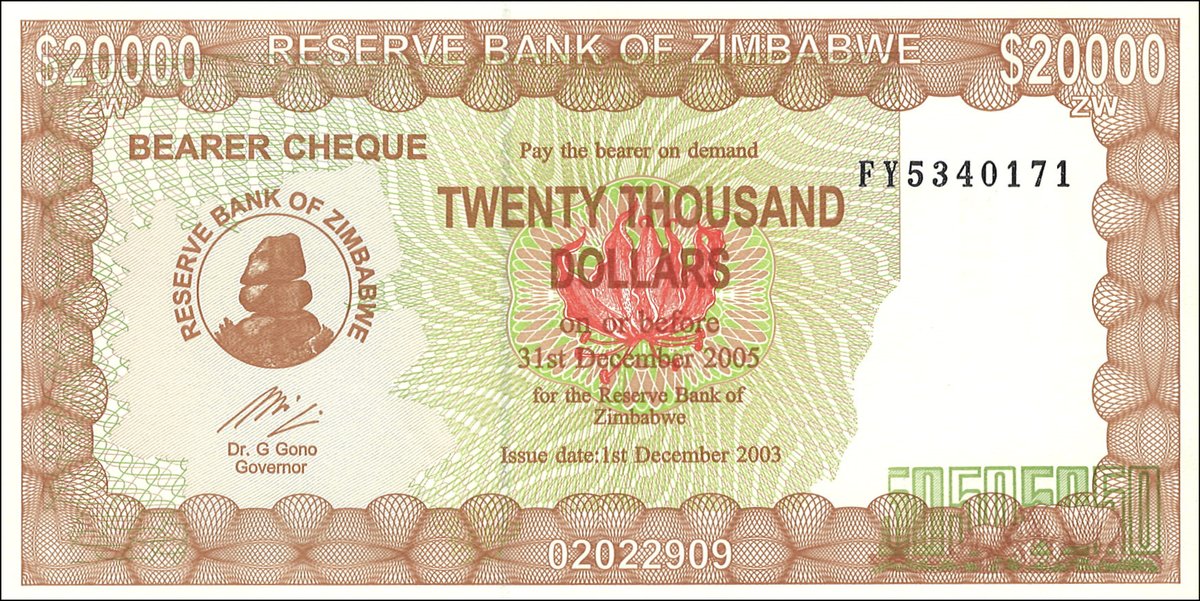
1 Dec 2003
20,000 dollars, bearer cheque (1 Dec 2003)
Aug 2006
First redenomination, 3 zeros: the "second dollar" (ZWN).
dated
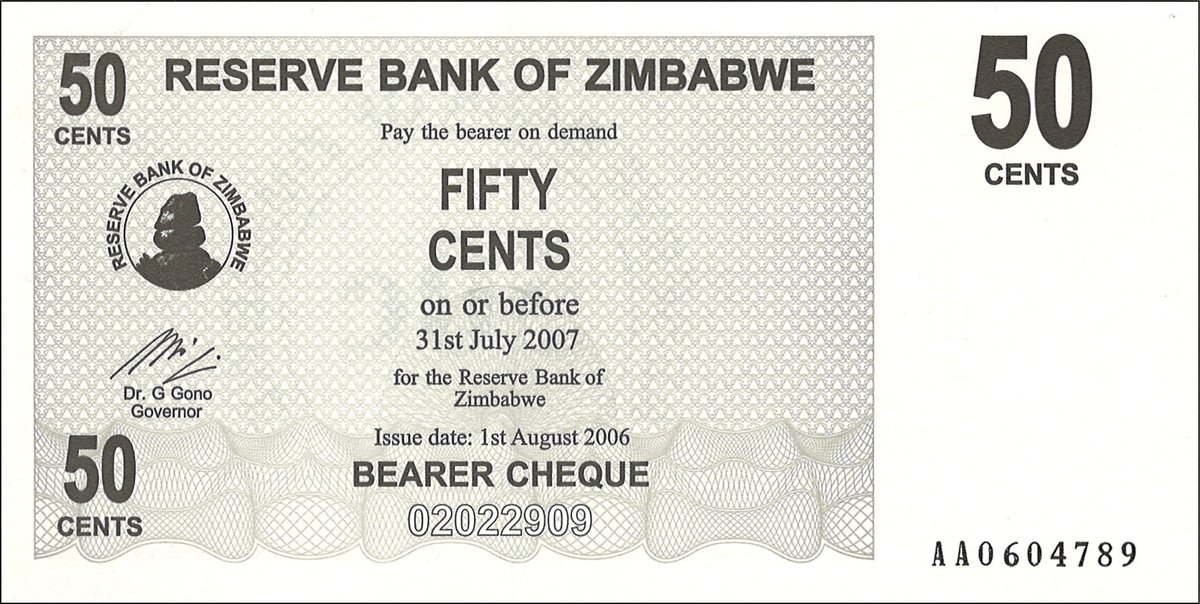
1 Aug 2006
50 cents, bearer cheque (1 Aug 2006)
dated
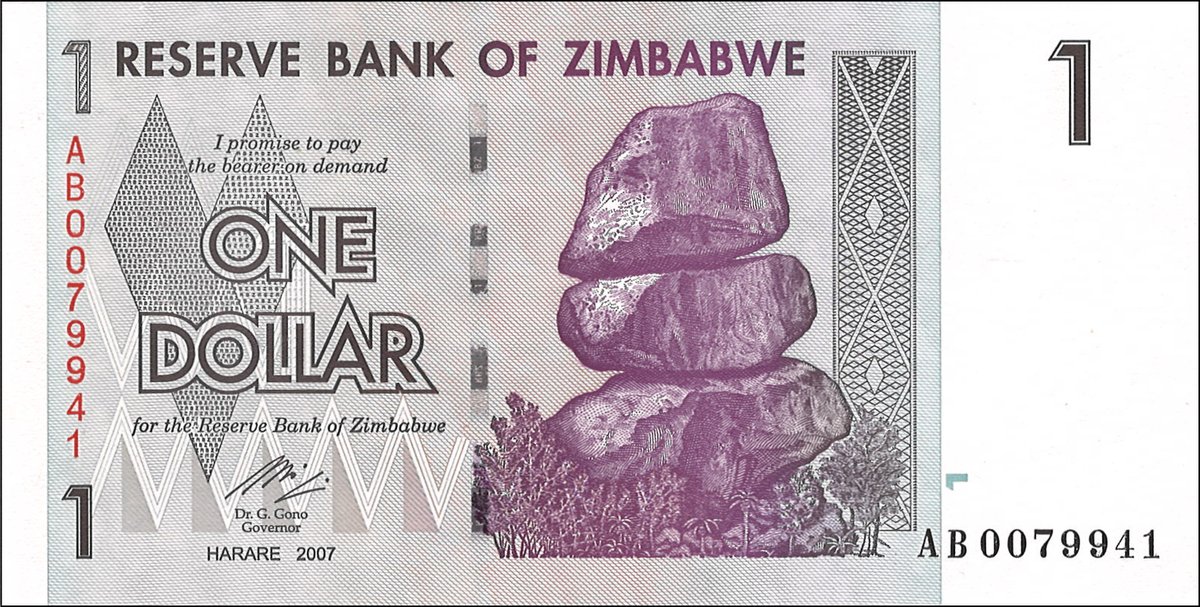
2007
1 dollar (Harare 2007)
Mar 2007
Monthly inflation crosses 50% (H&K start). Official 2007 annual rate 662,000%.
dated
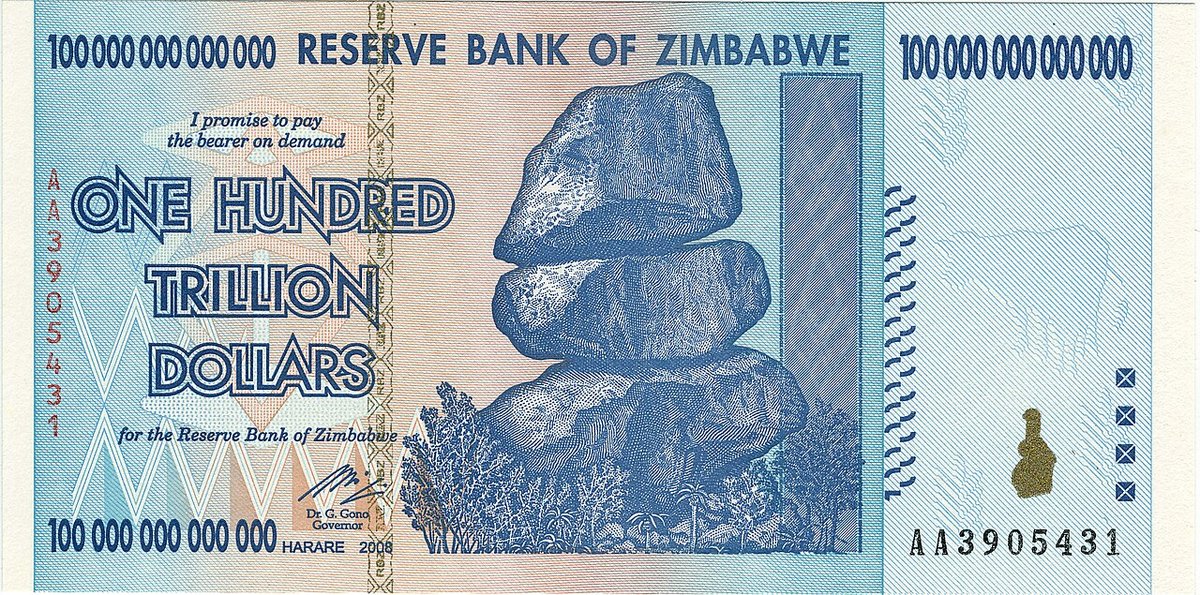
2008
100 trillion dollars (Harare 2008)
dated
2008
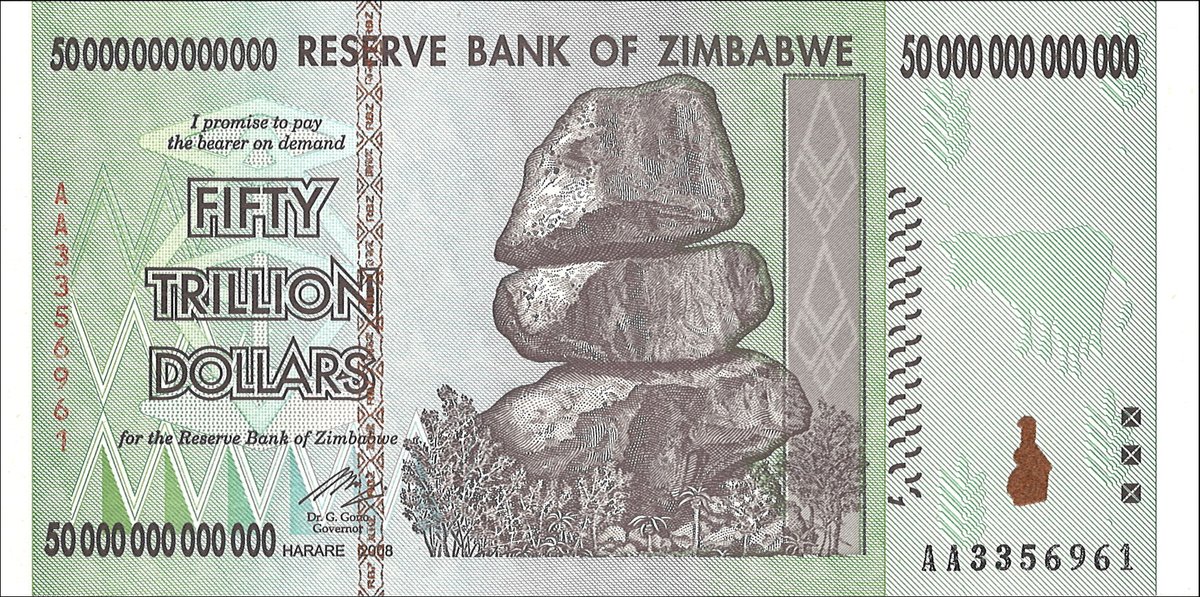
50 trillion dollars (Harare 2008)
dated
2008
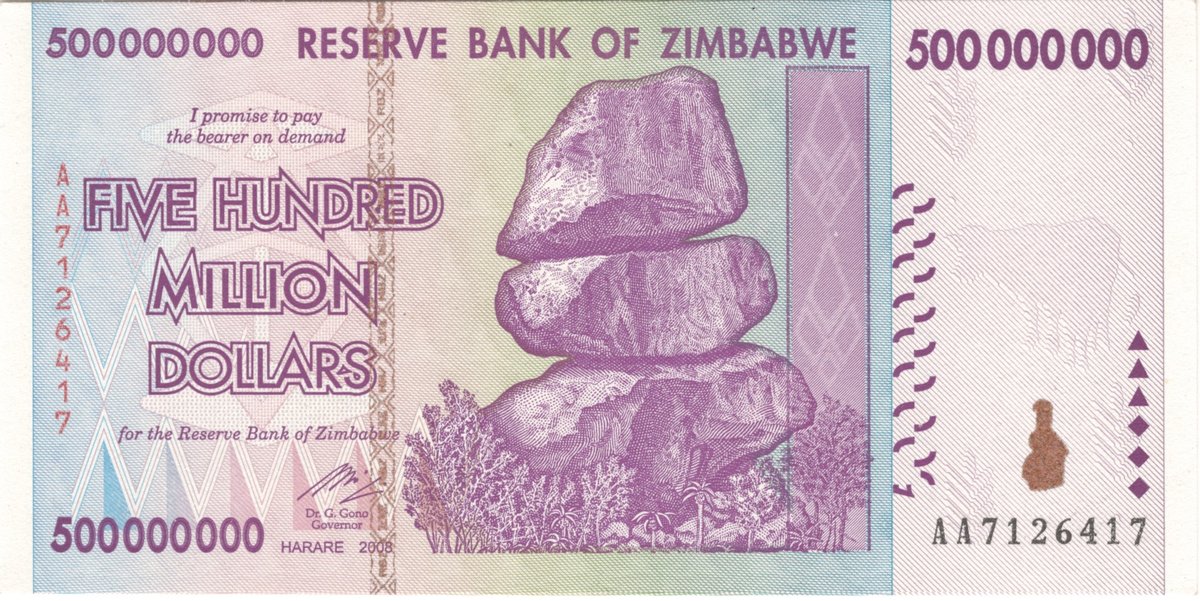
500 million dollars (Harare 2008)
dated
15 May 2008
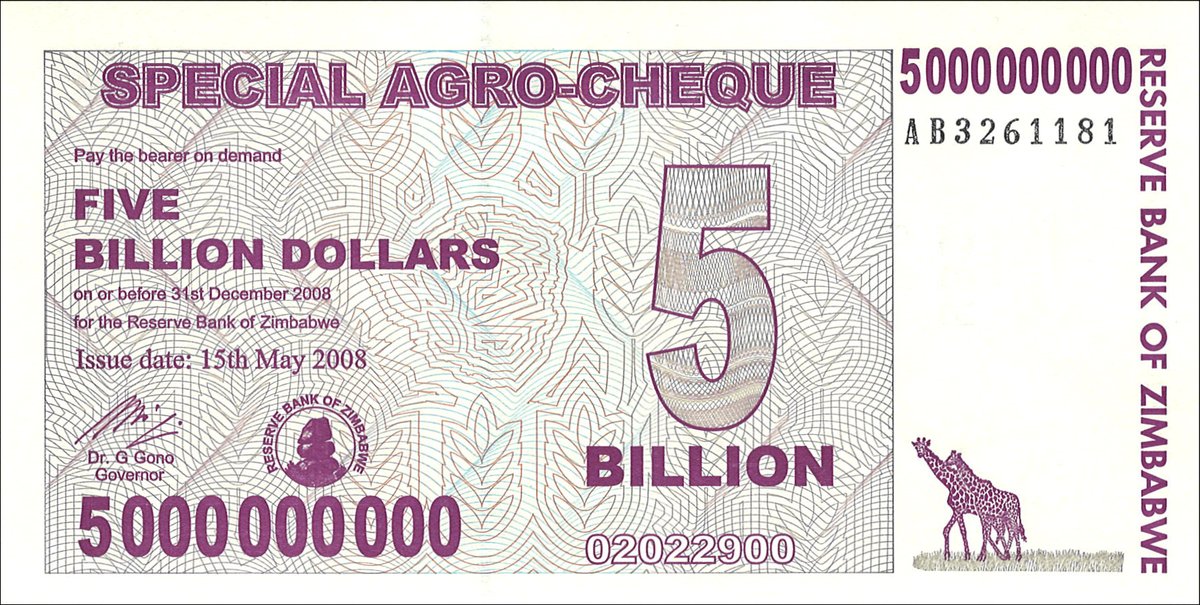
5 billion dollars, agro-cheque (15 May 2008)
Jul 2008
Last official CPI release.
dated
1 Jul 2008
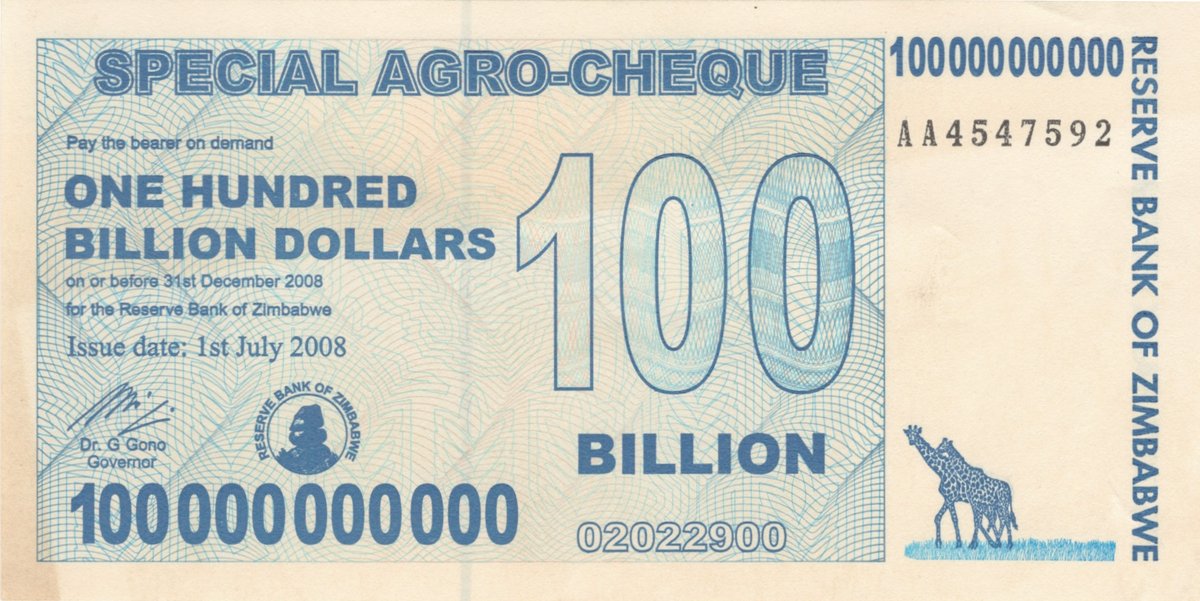
100 billion dollars, agro-cheque (1 Jul 2008)
Jul/Aug 2008
Second redenomination, 10 zeros: the "third dollar" (ZWR).
mid-Nov 2008
Peak: 79.6 billion % in the month (H&K).
early 2009
The Z$100 trillion note.
Feb 2009
Third redenomination, 12 zeros: the "fourth dollar" (ZWL).
Apr 2009
The Zimbabwe dollar is suspended; trade in US dollars, rand and others.
Context: why it happened

  • Collapse of supply. From 2000 the "fast-track" land reform seized commercial farms; farm output, exports and foreign-currency earnings fell, and with them the tax base.
  • The central bank as the state's wallet. The Reserve Bank of Zimbabwe, under governor Gideon Gono (2003–2013), printed to fund the budget, the war in the DR Congo (1998–2002), and quasi-fiscal "facilities" for farmers and state firms.
  • Price and exchange controls. Fixed prices emptied the shops; a fixed official rate created a parallel market that became the real price of everything.
  • Statistics stopped. Official CPI ceased after July 2008; the peak figures are implied from the Old Mutual share price ratio / parallel rate (Hanke's method), not official.

Life during it

  • Shelves emptied under price controls; goods moved to the parallel market.
  • Cash withdrawal limits made banknotes scarce while they were worthless: queues for money that lost value in the queue.
  • People held US dollars, rand, fuel coupons and goods; prices were set in foreign currency.

How it ended

There was no reform of the currency: the currency was abandoned. From 2009 a multi-currency system (mostly US dollars) stopped inflation at once — the state could no longer print what people used.

Consequences & lessons

  • Dollarisation ends inflation instantly because it takes the press away from the state — the cleanest proof that the anchor is what ends it.
  • Price controls and a false official rate do not slow inflation; they move trade to the parallel market and destroy supply.
  • When official statistics stop, the parallel exchange rate becomes the price index.

The banknotes

The data

figurevaluesource
Hyperinflation (≥ 50%/month)Mar 2007 – mid-Nov 2008H&K
Peak monthmid-November 2008H&K
Peak monthly inflation7.96 × 10¹⁰ % (79.6 billion %)H&K
Doubling time at peak24.7 hoursH&K
Official annual inflation 2005 · 2006 · 2007586% · 1,281% · 662,000%Wikipedia (Zimbabwe)
Redenomination Aug 20063 zeros (1,000 : 1)Wikipedia (Zimbabwe)
Redenomination Feb 200912 zeros (10¹² : 1)Wikipedia (Zimbabwe)
Currency abandonedApril 2009 (multi-currency: USD, rand, pula…)Wikipedia (Zimbabwe)
The series, point by point
Monthper $
2007-0130,000
2007-03120,000
2007-06350,000
2007-09750,000
2007-122 million
2008-014.5 million
2008-0325 million
2008-05200 million
2008-0710 billion
2008-08100 billion
2008-091 trillion
2008-10100 trillion
2008-112.6×10¹⁸
Cite this case
“Zimbabwe 2007–2009”, Hyperinflation Archive, hyperinflation.rogzy.org/zimbabwe-2007-2009/ (2026). Figures: Hanke & Krus (2012) and the sources listed below.

Sources

  1. Hanke & Krus (2012), World Hyperinflations, Cato WP no. 8 — dates, peak, doubling time.
  2. Hanke, S. H. & Kwok, A. K. F.
  3. Wikipedia, "Hyperinflation in Zimbabwe" — redenominations, official rates, abandonment (read 2026-10-05): https://en.wikipedia.org/wiki/Hyperinflation_in_Zimbabwe

H&K = Hanke, S. H. & Krus, N. (2012), World Hyperinflations, Cato Institute Working Paper no. 8.

Further reading

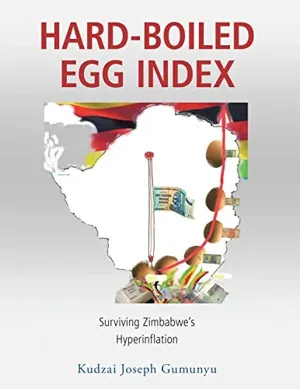
More in the Library. Books, covers and descriptions from Plan B Network’s open educational content, CC BY-SA 4.0, with titles, names and punctuation corrected.