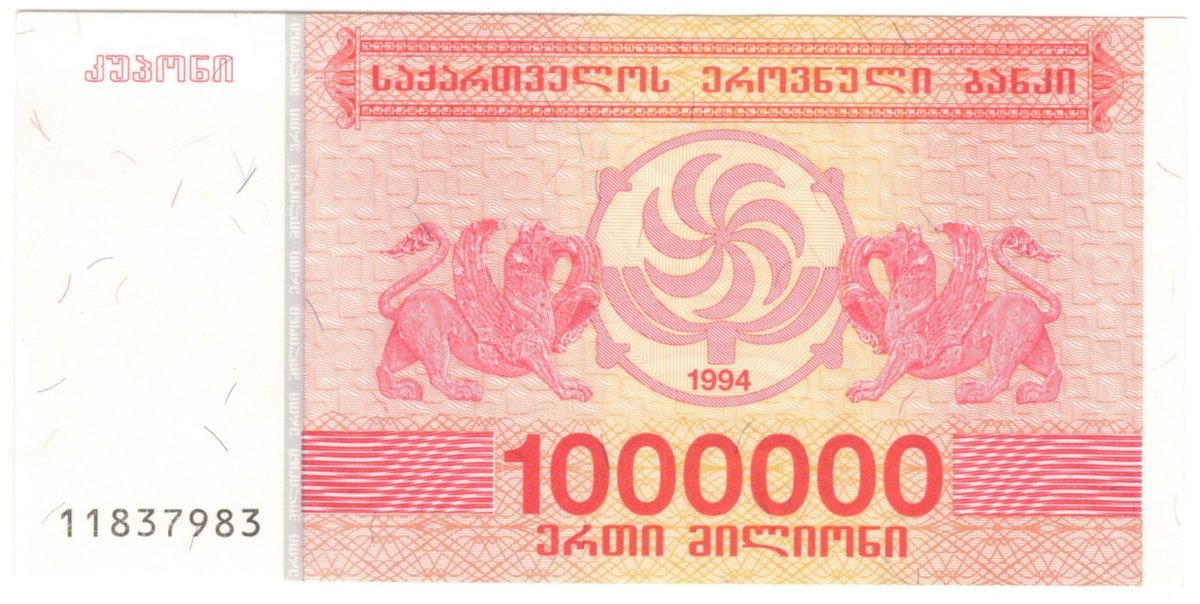
1994

Cases / The end of communism / Georgia
Newly independent Georgia was fighting civil wars (Abkhazia, South Ossetia, the Gamsakhurdia loyalists) and had lost its Soviet markets and Russian energy.
Currency reform: 1 lari = 1,000,000 kuponi · Cause: Civil war, a deficit paid with the kuponi · Resolution: IMF-backed programme, then the lari (1995)
It issued a temporary "coupon" currency, the kuponi, and financed the state with it. Hyperinflation ran from September 1993 to September 1994 and peaked at the very end: 211 % in September 1994, doubling every 18.6 days (H&K). In 1995 one lari replaced a million kuponi.
Kuponi per 1 USD, logarithmic scale: each line up is many times the one below.
The kuponi replaced the ruble at par on 5 April 1993. Hyperinflation from September 1993 to September 1994, peak 211% in September 1994 (Hanke & Krus). The lari replaced it on 2 October 1995 at 1,000,000 kuponi. Approximate series, kept for its shape; individual points are not sourced one by one. Source: National Bank of Georgia, IMF Working Paper - The Georgian Hyperinflation and Stabilization (1999).
The events in order, with the banknotes at the date on them.

The lari was not a magic unit: it came last.
| figure | value | source |
|---|---|---|
| Hyperinflation (≥ 50%/month) | Sep 1993 – Sep 1994 | H&K |
| Earlier episode | Mar – Apr 1992, 198 %, while the currency was still the Russian ruble | H&K |
| Peak month | September 1994 | H&K |
| Peak monthly inflation | 211 % | H&K |
| Doubling time at peak | 18.6 days | H&K |
| Kuponi | 5 Apr 1993, replacing the ruble at par; no coins | Wikipedia (Georgian kuponi) |
| Largest note | 1,000,000 kuponi (1994) | Wikipedia (Georgian kuponi) |
| Lari | 2 Oct 1995, 1 lari = 1,000,000 kuponi | Wikipedia (Georgian kuponi) |
| Month | per $ |
|---|---|
| 1993-04 | 2 |
| 1993-06 | 25 |
| 1993-09 | 600 |
| 1993-12 | 4,500 |
| 1994-03 | 85,000 |
| 1994-06 | 450,000 |
| 1994-09 | 1.8 million |
| 1994-12 | 2.4 million |
H&K = Hanke, S. H. & Krus, N. (2012), World Hyperinflations, Cato Institute Working Paper no. 8.