1 Jan 2005
The new Turkish lira removes six zeros.
Cases / Contrast case / Turkey
This is not a hyperinflation. Turkey had decades of chronic high inflation, tens of percent a year with crises (1994, 2001), but it never reached 50 % in one month, so it is absent from the H&K table.
Contrast case: never 50% in a month, so not a hyperinflationCurrency reform: 1 new lira = 1,000,000 old (2005) · Cause: Chronic deficits — high inflation for decades, never a hyperinflation · Resolution: Independent central bank, six zeros removed (2005)
The lira went from 80 per dollar in 1980 to 1,350,000 in 2005. It was the world's least valued currency in 1995–96 and again in 1999–2004, until six zeros were removed on 1 January 2005. It is a contrast case: what inflation does without ever turning into a hyperinflation.
Lira per 1 USD, logarithmic scale: each line up is many times the one below.
Chronic high inflation, never 50% in a month: not a hyperinflation. The lira was the world's least valued currency in 1995–96 and 1999–2004 (Wikipedia). On 1 January 2005, 1,000,000 old lira became 1 new lira. Approximate series, kept for its shape; individual points are not sourced one by one. Source: Central Bank of Turkey, World Bank, FRED - Federal Reserve Economic Data.
The events in order, with the banknotes at the date on them.
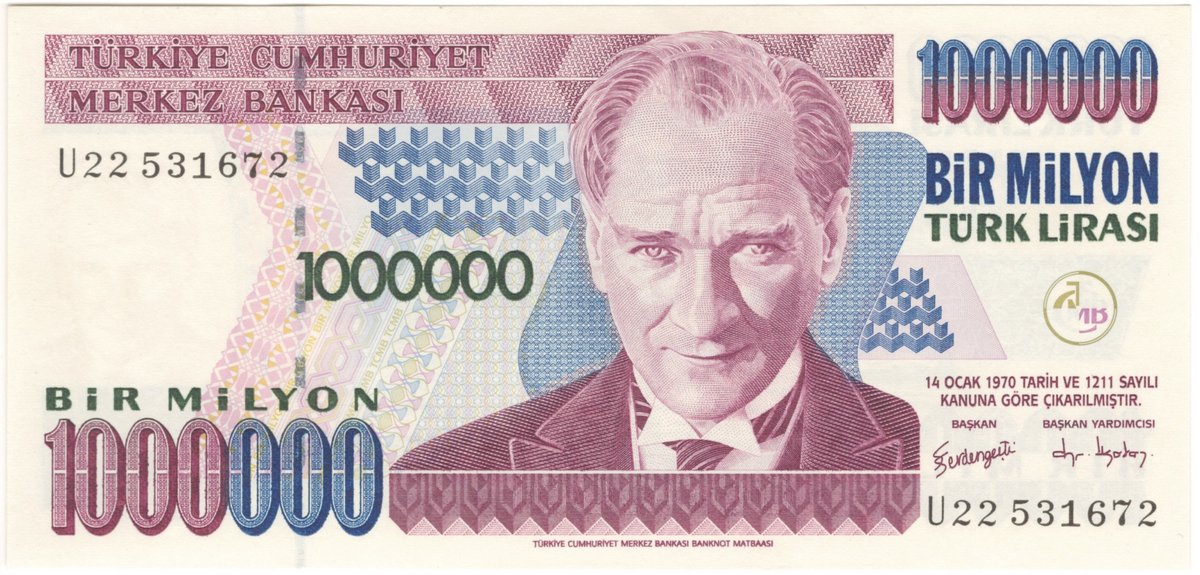
| figure | value | source |
|---|---|---|
| Hyperinflation | none; not in H&K | H&K (absence) |
| Lira per USD (yearly average) | 80 (1980) · 500 (1985) · 2,500 (1990) · 43,000 (1995) · 620,000 (2000) · 1,250,000 (2001) · 1,350,000 (2005) | Wikipedia (Turkish lira) |
| World's least valued currency | 1995–96, 1999–2004 | Wikipedia (Turkish lira) |
| Redenomination | 1 Jan 2005, 1 YTL = 1,000,000 TL | Wikipedia (Turkish lira) |
| Month | per $ |
|---|---|
| 1990-01 | 2,310 |
| 1990-12 | 2,930 |
| 1991-12 | 5,080 |
| 1992-12 | 8,560 |
| 1993-12 | 14,500 |
| 1994-04 | 38,000 |
| 1994-12 | 38,500 |
| 1995-12 | 59,500 |
| 1996-12 | 107,500 |
| 1997-12 | 205,000 |
| 1998-12 | 314,500 |
| 1999-12 | 545,500 |
| 2000-12 | 677,000 |
| 2001-02 | 960,000 |
| 2001-10 | 1.65 million |
| 2002-12 | 1.65 million |
| 2003-12 | 1.4 million |
| 2004-12 | 1.34 million |
H&K = Hanke, S. H. & Krus, N. (2012), World Hyperinflations, Cato Institute Working Paper no. 8.