Hyperinflation/Archive

Cases / The end of communism / Poland

Poland
1989–1990

As communism ended in 1989, controlled prices were freed while wages stayed indexed and the budget was financed by the central bank.

77.3%prices in the worst monthJanuary 1990
36.8 daysfor prices to doubleat the peak (Hanke & Krus)
Oct 1989 – Jan 1990above 50% a monththe hyperinflation itself
1banknotes in the collectionZłoty

Currency reform: 1 new złoty = 10,000 old (1995) · Cause: End of communism, indexed wages, a deficit paid with money · Resolution: Balcerowicz Plan (1 Jan 1990): budget fix, dollar anchor

In short

Prices rose more than 50 % a month from October 1989. The peak was 77.3 % in January 1990, doubling every 36.8 days (H&K): the month the Balcerowicz Plan freed nearly every price at once, made the złoty convertible and fixed it to the dollar. After that month the hyperinflation was over.

The curve

Złoty per 1 USD, logarithmic scale: each line up is many times the one below.

100 1,000 10,000 100,000 1989 1990 1991 1989-01: 510 1989-03: 780 1989-06: 1,200 1989-08: 2,150 1989-10: 4,500 1989-12: 6,500 1990-01: 9,500 1990-06: 9,500 1990-12: 9,500 1991-05: 11,100 Worst month

Hyperinflation from October 1989 to January 1990, peak 77.3% in January 1990 (Hanke & Krus). From 1 January 1990 the złoty was fixed to the dollar (9,500 in 1990) under the Balcerowicz Plan. In 1995, 10,000 old złoty became 1 new złoty. Approximate series, kept for its shape; individual points are not sourced one by one. Source: National Bank of Poland, IMF - Moderate Inflation in Poland.

What happened

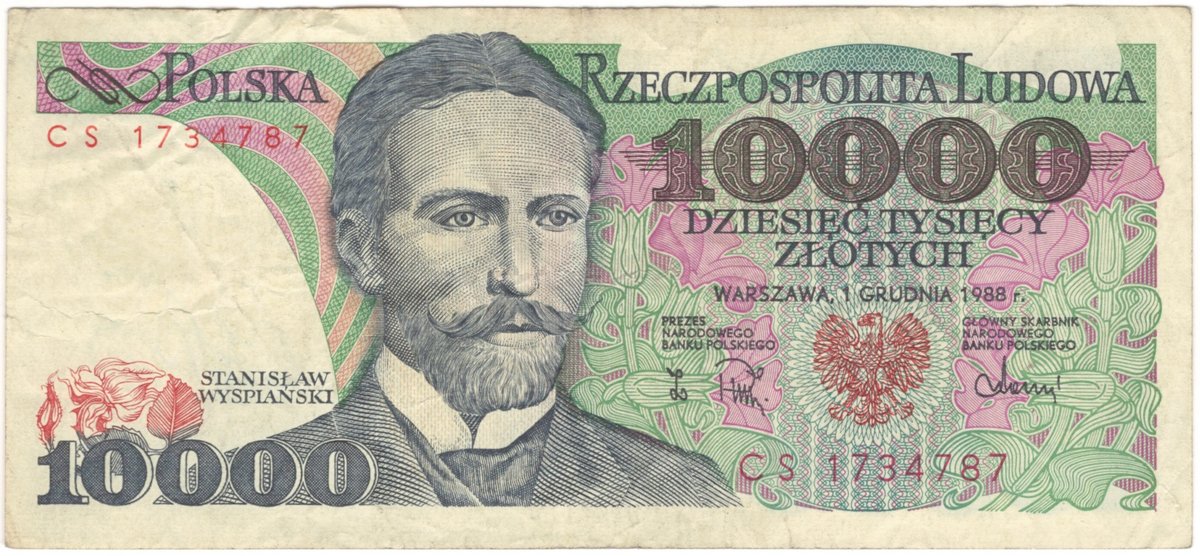
The events in order, with the banknotes at the date on them.

dated
1 Dec 1988
10,000 złotych (1 Dec 1988)
Sep 1989
Tadeusz Mazowiecki's government; Leszek Balcerowicz becomes finance minister.
Oct 1989
Monthly inflation passes 50 % (H&K start). On 6 October the plan is presented on television.
Dec 1989
The Sejm passes ten laws, signed on 31 December.
Jan 1990
Peak 77.3 % (H&K); real wages fall more than 40 % over two months.
1995
The new złoty removes four zeros.

Context: why it happened

  • A shortage economy. Controlled prices, empty shops and a growing pile of money nobody could spend.
  • The central bank financed the deficit and the state firms.

How it ended

The ending was planned: a fiscal fix, a ban on central-bank credit to the state, wage restraint, and an exchange-rate anchor backed by a $1 billion stabilisation fund that never had to be spent. The cost was a sharp recession in 1990–91, followed by the fastest recovery in post-communist Europe.

The banknotes

The data

figurevaluesource
Hyperinflation (≥ 50%/month)Oct 1989 – Jan 1990H&K
Peak monthJanuary 1990H&K
Peak monthly inflation77.3 %H&K
Doubling time at peak36.8 daysH&K
Annual inflation640 % (1989) · 249 % (1990)Wikipedia (Balcerowicz Plan)
Exchange-rate anchorzłoty fixed from 1 Jan 1990 for about a year and a half; 9,500 per USD in the 1990 rate tableWikipedia (Balcerowicz Plan · Polish złoty)
Stabilisation fundUS$1 billion, plus a $720 million IMF stand-byWikipedia (Balcerowicz Plan)
Redenomination1 Jan 1995, 1 PLN = 10,000 PLZWikipedia (Polish złoty)
The series, point by point
Monthper $
1989-01510
1989-03780
1989-061,200
1989-082,150
1989-104,500
1989-126,500
1990-019,500
1990-069,500
1990-129,500
1991-0511,100
Cite this case
“Poland 1989–1990”, Hyperinflation Archive, hyperinflation.rogzy.org/poland-1989-1990/ (2026). Figures: Hanke & Krus (2012) and the sources listed below.

Sources

  1. Hanke & Krus (2012) — episode, peak, doubling time.
  2. Wikipedia, "Polish złoty" (read 2026-10-05): https://en.wikipedia.org/wiki/Polish_z%C5%82oty
  3. Wikipedia, "Balcerowicz Plan" (read 2026-10-05): https://en.wikipedia.org/wiki/Balcerowicz_Plan

H&K = Hanke, S. H. & Krus, N. (2012), World Hyperinflations, Cato Institute Working Paper no. 8.