Hyperinflation/Archive

Cases / Latin America's debt crisis / Peru

Peru
1988–1990

The inti was created in 1985 to replace a sol already worn down by inflation.

397%prices in the worst monthAugust 1990
13.1 daysfor prices to doubleat the peak (Hanke & Krus)
Sep 1988 · Jul – Aug 1990above 50% a monththe hyperinflation itself
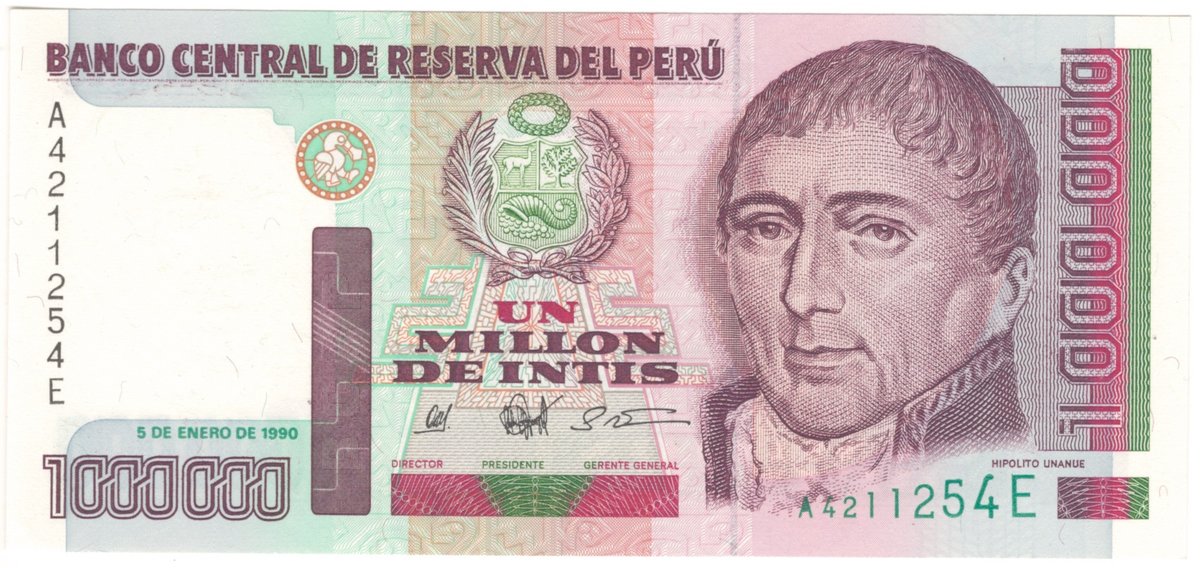
1banknotes in the collectionInti

Currency reform: 1 nuevo sol = 1,000,000 intis · Cause: Price controls, a deficit paid by the central bank · Resolution: The "Fujishock" (Aug 1990), then the nuevo sol (1991)

In short

Under price controls, a debt-service cap and deficits financed by the central bank, it went into hyperinflation twice: 114 % in September 1988, then 397 % in August 1990 — the month of the stabilisation shock itself — with prices doubling every 13.1 days (H&K). In 1991 one nuevo sol replaced a million intis.

The curve

Intis per 1 USD, logarithmic scale: each line up is many times the one below.

10 100 1,000 10,000 100,000 1 million 1988 1989 1990 1988-01: 33 1988-06: 250 1988-09: 900 1988-12: 2,000 1989-03: 5,500 1989-06: 15,000 1989-09: 35,000 1989-12: 75,000 1990-03: 145,000 1990-06: 250,000 1990-07: 350,000 1990-08: 500,000 Worst month

Two hyperinflation episodes: September 1988 (114%) and July–August 1990, peak 397% in August 1990 (Hanke & Krus). The nuevo sol replaced 1,000,000 intis on 1 July 1991. Approximate series, kept for its shape; individual points are not sourced one by one. Source: Banco Central de Reserva del Perú.

What happened

The events in order, with the banknotes at the date on them.

1 Feb 1985
The inti replaces the sol de oro at 1,000 : 1.
Sep 1988
A devaluation package; prices rise 114 % in the month (H&K).
dated
5 Jan 1990
1 million intis (5 Jan 1990)
28 Jul 1990
Alberto Fujimori takes office.
Aug 1990
Prices rise 397 % in the month (H&K).
1 Jul 1991
The nuevo sol replaces the inti at 1 : 1,000,000.

Context: why it happened

  • The central bank financed the deficit while tax receipts collapsed with inflation (the Olivera–Tanzi effect: taxes are paid in money that has lost value by the time it arrives).

How it ended

The Fujishock was the textbook "pain first" exit: freed prices, a balanced cash budget (spend only what was collected), a floating exchange rate and a return to creditors. The nuevo sol has been one of Latin America's steadiest currencies since.

Consequences & lessons

  • Price controls hide inflation; they do not stop it. Lifting them produced the worst single month — the bill for every month they had hidden.

The banknotes

The data

figurevaluesource
Hyperinflation episodesSep 1988 · Jul – Aug 1990H&K
Peak monthAugust 1990H&K
Peak monthly inflation397 %H&K
Doubling time at peak13.1 daysH&K
First spike114 % (Sep 1988)H&K
Inti introduced1 Feb 1985, 1 inti = 1,000 soles de oroWikipedia (Peruvian inti)
Largest note5,000,000 intis (1990; overprinted variant Jan 1991)Wikipedia (Peruvian inti)
Nuevo sol1 Jul 1991, 1 sol = 1,000,000 intisWikipedia (Peruvian inti)
The series, point by point
Monthper $
1988-0133
1988-06250
1988-09900
1988-122,000
1989-035,500
1989-0615,000
1989-0935,000
1989-1275,000
1990-03145,000
1990-06250,000
1990-07350,000
1990-08500,000
Cite this case
“Peru 1988–1990”, Hyperinflation Archive, hyperinflation.rogzy.org/peru-1988-1990/ (2026). Figures: Hanke & Krus (2012) and the sources listed below.

Sources

  1. Hanke & Krus (2012) — episodes, peak, doubling time.
  2. Wikipedia, "Peruvian inti" (read 2026-10-05): https://en.wikipedia.org/wiki/Peruvian_inti

H&K = Hanke, S. H. & Krus, N. (2012), World Hyperinflations, Cato Institute Working Paper no. 8.