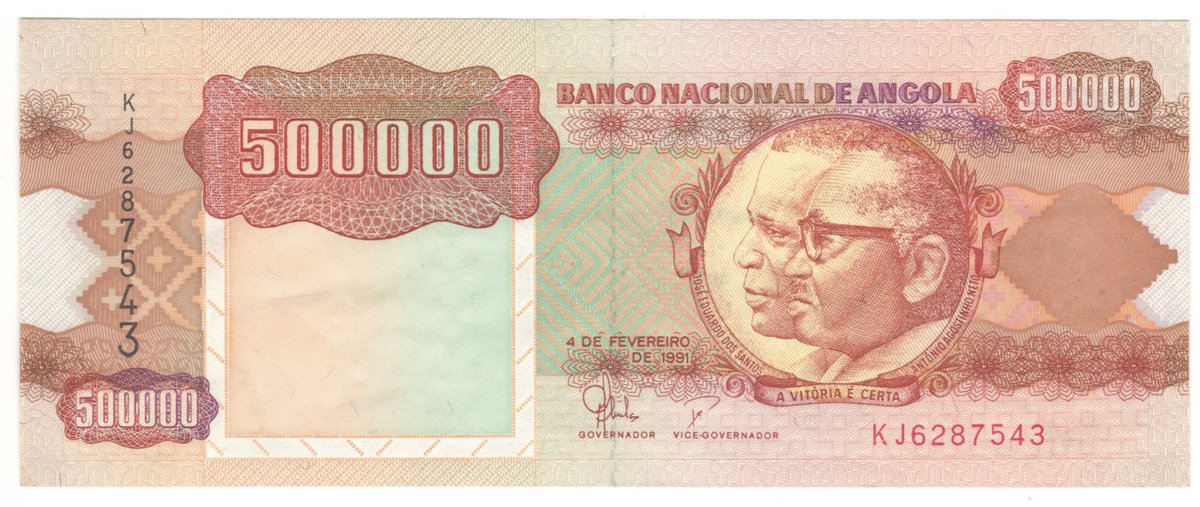
4 Feb 1991

Cases / Wars in Africa / Angola
During the civil war between the MPLA government and UNITA, and with an economy living on oil, the state paid for the war with the central bank.
Currency reform: 1 kwanza = 1,000,000,000 novos kwanzas · Cause: Civil war, a deficit paid by the central bank · Resolution: Two redenominations; the war ended in 2002
The kwanza was reformed three times in a decade. Hyperinflation in the strict sense ran from December 1994 to January 1997. It peaked at 84.1 % in May 1996, doubling every 34.5 days (H&K).
No exchange-rate chart for this case yet: no series we could source month by month. The figures that matter are in the text and the key figures below, each with its source.
The events in order, with the banknotes at the date on them.

| figure | value | source |
|---|---|---|
| Hyperinflation (≥ 50%/month) | Dec 1994 – Jan 1997 | H&K |
| Peak month | May 1996 | H&K |
| Peak monthly inflation | 84.1 % | H&K |
| Doubling time at peak | 34.5 days | H&K |
| Novo kwanza | 25 Sep 1990, at par, but only 5 % of old notes could be exchanged | Wikipedia (Angolan kwanza) |
| Kwanza reajustado | 1 Jul 1995, 1 = 1,000 novos kwanzas | Wikipedia (Angolan kwanza) |
| Kwanza (AOA) | 1 Dec 1999, 1 = 1,000,000 reajustados | Wikipedia (Angolan kwanza) |
| Largest notes | 500,000 kwanzas (1991) · 5,000,000 kwanzas reajustados | Wikipedia (Angolan kwanza) |
H&K = Hanke, S. H. & Krus, N. (2012), World Hyperinflations, Cato Institute Working Paper no. 8.